THE WARM-UP: WHERE WE LEFT OFF
Last week, we broke down how the Finance Bill 2026’s amendment to the Inverted Duty Structure finally puts domestic manufacturers on the front foot, with no more chasing your own GST refunds through bureaucratic limbo. We closed by stepping off the cricket pitch and heading to the global arena.
This week, we are here, and the Strait of Hormuz LPG price hike in India 2026 is the story that every household and business needs to understand right now.
On February 28, 2026, a single event thousands of kilometres away triggered a chain reaction that ended with a ₹60 jump on your gas cylinder and rising costs inside every Indian business’s supply chain. The global arena just walked into your kitchen and it demands your attention.
THE SHORT VERSION, IF YOU ARE IN A HURRY
On February 28, 2026, the United States and Israel launched joint military strikes on Iran. Within hours, the world’s most important route for oil and gas ships, the Strait of Hormuz, effectively shut down.
On March 7, 2026, the price of a domestic LPG cylinder in India went up by ₹60. Commercial cylinders, the ones used by restaurants and food businesses, jumped by ₹115.
Social media was flooded with warnings of imminent restaurant closures and empty cylinders. The reality is more nuanced than either the panic or the dismissals suggest. Household LPG supply is stable, no dry-outs have been reported at retail outlets across the country, and the government has moved swiftly to manage the situation. The price hike is real. The booking rules have tightened. But the full-blown shortage that social media predicted has not materialised.
WHAT IS THE STRAIT OF HORMUZ AND WHY SHOULD YOU CARE?
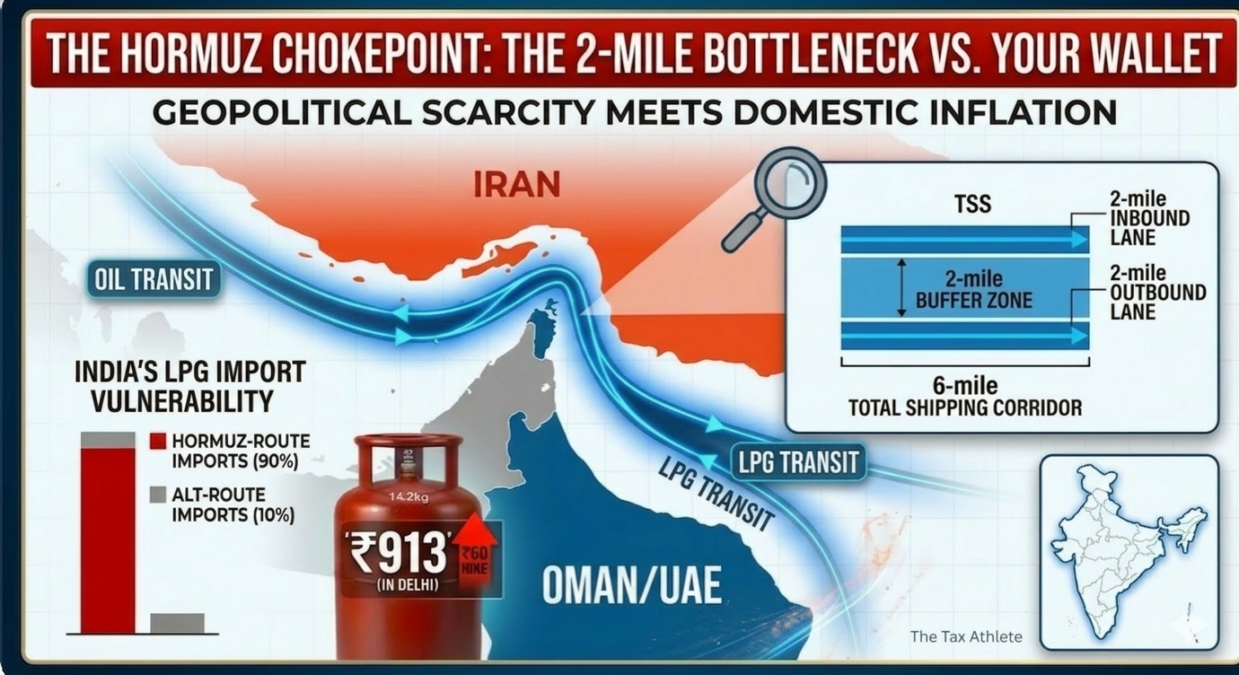
Think of the Strait of Hormuz as a long, narrow corridor, like a single lane highway, that connects the oil-rich countries of the Middle East to the rest of the world. It sits between Iran on one side and Oman on the other.
At its narrowest, this corridor is only 21 nautical miles wide. But the actual lanes where oil ships travel are much tighter, just 2 miles wide for ships coming in, 2 miles wide for ships going out, and a 2-mile buffer zone in between. Six miles of designated shipping corridor. That is all that stands between normal energy supply and a global crisis.
According to the US Energy Information Administration (EIA) and the IEA’s March 2026 Oil Market Report, roughly 20 million barrels of oil and petroleum products passed through this corridor every single day in 2025, about 25% of the world’s entire seaborne oil supply. On top of that, nearly all cooking gas exports from Qatar and the UAE also travel through this same route. The IEA has called the current disruption the largest oil supply shock in the history of the global energy market.
Here is a simple way to picture it. Imagine the entire city of Mumbai’s water supply running through a single pipe. Now imagine someone threatening to block that pipe. That is exactly what is happening to the world’s energy supply right now.
A Tax-Athlete reads the playing field before stepping onto it. This is the playing field right now.
INDIA AND THE HORMUZ CRISIS: WHERE WE STAND
India is navigating this crisis better than most countries. That said, the impact is not uniform across all fuels. The picture depends entirely on which fuel you are talking about.
India’s LPG Imports: Understanding the Exposure
To understand why your cooking gas price went up, you need to understand where India gets it from.
- India produces only about 38% of the LPG it needs. The remaining 62% is imported (PPAC)
- Of that imported gas, 80 to 90% travels through the Strait of Hormuz
- India’s two biggest suppliers, Qatar and the UAE, have no other major route to send us gas.
More than half of India’s total cooking gas supply depends on that single six-mile corridor staying open. The government has responded by issuing emergency directives to all refineries to maximise LPG production, with domestic output increasing significantly within days, and by actively sourcing alternative supply from the US, Canada, Norway, and Russia.
India’s Diplomatic and Naval Response: The Real Story
This is where India’s story gets genuinely remarkable, and where most coverage has fallen short.
On March 12, Prime Minister Modi held direct talks with Iranian President Pezeshkian, making clear that the safety of Indian nationals and the unhindered movement of Indian ships were non-negotiable. The result was immediate. On March 13, two Indian-flagged LPG tankers, MT Shivalik and MT Nanda Devi, both owned by the Shipping Corporation of India, crossed the Strait of Hormuz carrying a combined 92,712 metric tonnes of LPG and arrived at Mundra and Vadinar ports on March 16 and 17. A third vessel, the crude oil tanker Jag Laadki carrying 80,886 metric tonnes of crude, also arrived safely at Adani Ports Mundra on March 18.
These passages happened under Operation Sankalp, India’s ongoing naval mission to protect Indian commercial shipping in the Persian Gulf, launched in 2019. The Indian Navy had all air defence systems fully operational during the crossing. It is important to note that as External Affairs Minister Jaishankar has clarified, India does not have a blanket arrangement with Iran. Each passage is negotiated individually. There are still 22 Indian-flagged vessels waiting to cross. But the diplomacy is working and that matters enormously.
The Booking Interval Change and What It Really Tells Us
The government has also introduced new LPG booking rules worth understanding carefully, because they tell a more specific story than most coverage suggests.
The minimum gap between bookings for urban households has gone up from 21 days to 25 days. For rural and remote areas, it has jumped from 25 days to 45 days.
The urban increase of 4 days is modest, designed to slow down panic booking in cities. The rural increase of 20 days is far more significant. The real target is hoarding and diversion, where people book cylinders early and sell subsidised domestic gas to restaurants and commercial users at a marked-up price.
The key insight most coverage has missed is this: the government is managing this crisis on the demand side, not rationing on the supply side. The gas is there. It is the behaviour around it that needed correcting.
Where India Is Better Protected: Crude Oil
On crude oil, the fuel used to make petrol, diesel, and industrial energy, India has been quietly preparing for exactly this kind of situation.
Over the past two years, India deliberately shifted its crude oil purchases away from the Middle East and toward Russia and the United States. Today, about 70% of India’s crude oil arrives through routes that do not pass through the Strait of Hormuz at all, up from just 55% before tensions began rising.
According to Business Today, petrol in Delhi remains at ₹94.77/litre and diesel at ₹87.67/litre as of March 20. The government has confirmed that fuel prices are not going up immediately. Years of deliberate supply diversification are now paying off.
How India Compares to Other Countries
This is the context most news coverage leaves out, and it matters.
- Japan gets about 90% of its crude oil from the Middle East, almost all through Hormuz.
- South Korea has activated a 100 trillion won, roughly $68 billion, emergency fund to stabilise its markets.
- Bangladesh had to buy emergency cooking gas at nearly three times the normal price. Pakistan has stopped buying LNG altogether.
- In Europe, gas prices have nearly doubled since the conflict began.
India’s ₹60 cylinder hike of about 7% is real and it hurts. But the comparison tells the full story. India’s preparation and government management have clearly made a meaningful difference. The heaviest lifts reveal the strongest foundations, and right now, India’s foundation is holding.
THE ₹60 HIKE: WHY DID IT HAPPEN AND WHY NOW?
This price increase did not happen suddenly. It was months in the making.
Your gas cylinder was priced at ₹853 for a long time. Behind the scenes, Oil Marketing Companies, Indian Oil, BPCL, and HPCL, were quietly absorbing rising international costs so that your price at home stayed the same. Think of it like a shock absorber in a car. It was taking the bumps so you did not feel them.
The international price India pays for imported LPG is called the Saudi Contract Price. Between November 2025 and February 2026, this price went up by 16%, from around $466 per metric tonne to $542 per metric tonne. For four months, the OMCs held the domestic price steady. When the Strait of Hormuz closed in late February, the shock absorber finally gave way.
According to Outlook Money, after the March 7 hike, LPG now costs ₹913 per cylinder in Delhi, ₹912.50 in Mumbai, between ₹930 and ₹939 in Kolkata, and around ₹928 in Chennai.
THE BIGGER PICTURE: HOW THIS AFFECTS YOUR EVERYDAY COSTS
The cooking gas price is the most visible impact. But two other consequences are quietly building in the background.
According to MUFG Research, the research arm of Mitsubishi UFJ Financial Group, one of the world’s largest banks, for every $10 increase in global oil prices per barrel, India’s economic growth slows by 0.1 to 0.2 percentage points and inflation rises by about 0.2 percentage points. With Brent crude currently trading above $110 per barrel, that pressure is not a future risk. It is already here, and the Indian rupee has already hit a record low of ₹92.94 against the US dollar as of March 20.
The second impact is on food prices, and this one is less discussed but potentially more significant for Indian households. According to The National, India sources 66% of its imported urea and 50% of its LNG used to manufacture domestic fertiliser from the Gulf region. Global urea prices have already risen by up to 35% since the conflict began, according to ICIS, one of the world’s leading commodity price intelligence services. When fertiliser costs go up, farming costs go up. When farming costs go up, food prices follow. This does not show up in your grocery bill overnight, but it is already in motion.
THE TAX-ATHLETE PLAYBOOK: THREE STEPS FOR RIGHT NOW
You cannot control what happens in the Strait of Hormuz. But you can control how prepared your business is for what comes next. Here are three practical steps to take in the next 30 days.
1. Check Your Cash Flow Before the Next Bill Arrives
Every business that moves goods is already seeing higher transport costs. Road freight, air cargo, and shipping all carry fuel surcharges and those are going up. Sit down this week and map out your expected costs for the next 60 days. Identify which suppliers or service providers are likely to charge you more. A surprise cash shortfall in a high-cost environment can cripple even a healthy business. Find the pressure points now, while you still have time to act.
2. Keep Your Tax Filings Clean and On Time
When an athlete gets tired, their form slips and that is when injuries happen. When business margins tighten, compliance slips and that is when tax liabilities compound. The Ministry of Finance and the RBI pay the closest attention to business finances during periods of economic stress, exactly like the one we are in now. Clean records and on-time filings protect your credit rating, your banking relationships, and your standing with tax authorities. If you are unsure about your specific situation, speak with a qualified Chartered Accountant now rather than later.
3. Do Not Depend on a Single Supplier or Route
India spent two years quietly shifting its crude oil purchases away from the Middle East. That preparation is now paying off. Your business can apply the same logic at its own scale. If you depend on one logistics partner, one vendor, or one source of a key raw material, especially anything connected to the Gulf region, you are one disruption away from a serious problem. Start identifying backup options now. Adaptive recovery is not reactive. It is trained.
THE BOTTOM LINE
Your gas cylinder costs ₹60 more. Commercial LPG supply has been severely curtailed, with the government capping it at 20% of normal monthly volumes to prioritise household supply. The urban booking window has been extended by 4 days. Rural areas now face a 45-day interval, a deliberate move to stop hoarding and diversion, not a sign that supply is running out. No household dry-outs have been reported anywhere in the country. Petrol and diesel prices are holding steady.
There is also a genuine reason for cautious optimism. India’s diplomacy is working. Three Indian vessels have now safely crossed the Strait under Operation Sankalp and there are tentative signals that the conflict may de-escalate sooner than markets currently expect. But until ships move freely again, the pressure on supply chains remains real.
The real story here is not the crisis that wasn’t. It is the quiet, structural pressure building in the background. Rising oil prices, a weaker rupee, higher fertiliser costs and elevated freight charges are all moving in the same direction at the same time. None of these are dramatic enough to make a viral post. But all of them will show up in your business’s cost structure over the next 60 to 90 days if you are not paying attention.
The goal is not just to react when costs go up. The goal is to understand why they went up, see what is coming next and prepare before it arrives and that is the mindset worth building.
Up Next: The Inflation Sprint — how to protect your business margins when freight costs, raw material prices, and energy bills are all running faster than your revenue.
The price of a domestic LPG cylinder rose by ₹60 on March 7, 2026, for two connected reasons. First, the international LPG benchmark, the Saudi Contract Price, had been climbing steadily since November 2025. Second, the US-Israel military strikes on Iran disrupted the Strait of Hormuz, through which roughly 90% of India’s imported cooking gas normally travels. Oil Marketing Companies had been absorbing rising costs for months, but the combined pressure made a price revision unavoidable.
For household consumers, supply is stable and no dry-outs have been reported anywhere in the country. However, commercial LPG supply has been capped at 20% of normal monthly volumes, meaning restaurants, dhabas, and food businesses are under severe supply strain. The government has also introduced new booking intervals. Urban households must now wait 25 days between bookings, up from 21 days, while rural and remote households must wait 45 days, up from 25 days. These measures are designed to stop panic booking and the diversion of subsidised domestic cylinders to the black market.
As of March 20, 2026, petrol and diesel prices have not been increased, with petrol in Delhi at ₹94.77/litre and diesel at ₹87.67/litre. About 70% of India’s crude oil now arrives through routes that bypass the Strait of Hormuz entirely. However, with Brent crude currently above $110 per barrel and the rupee at a record low of ₹92.94 against the dollar, if global oil prices remain elevated, a revision cannot be ruled out.
Disclaimer: This blog is for general informational purposes only and does not constitute financial, tax, or investment advice. For advice specific to your business or personal situation, please consult a qualified Chartered Accountant or financial advisor.