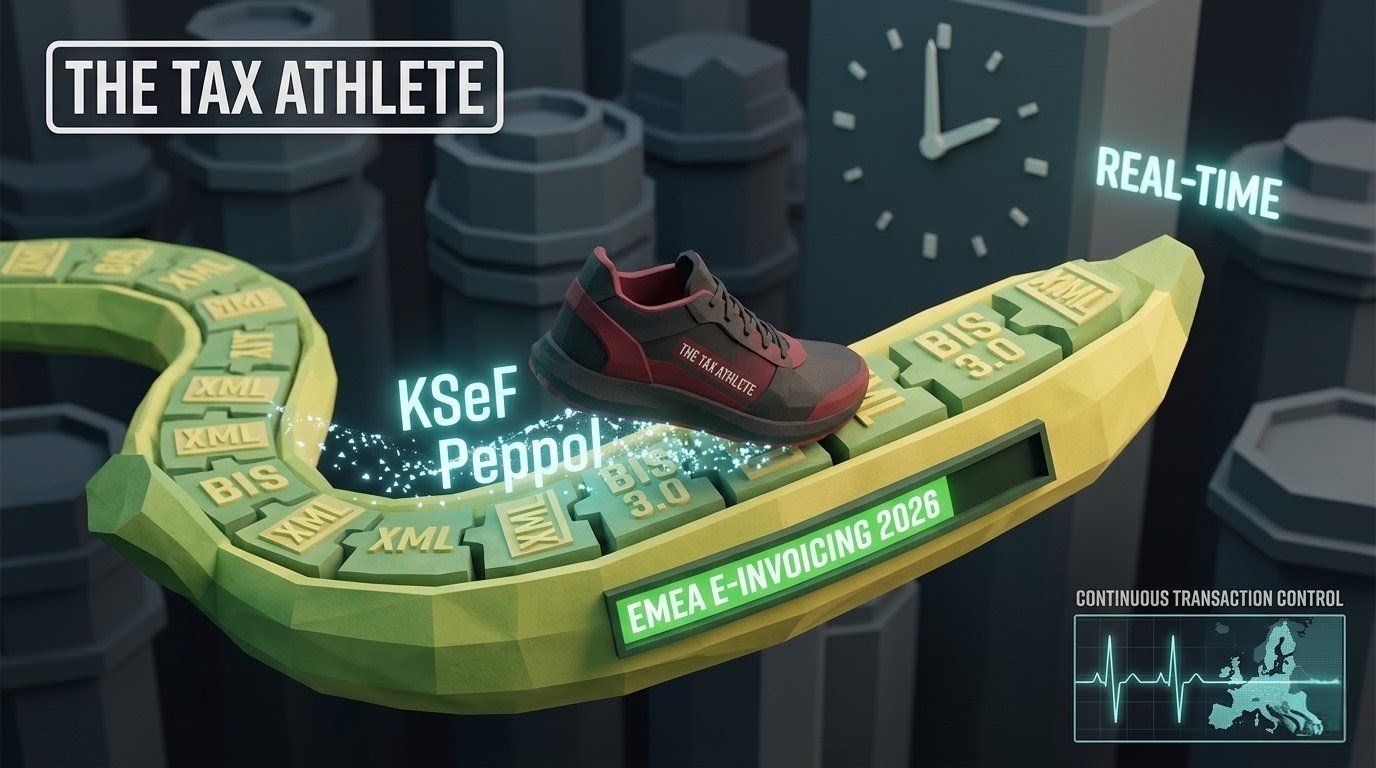
Warm-Up: From Carbon to Digital
In the last post in this series, The Green Ledger: India, CBAM and the Carbon Tax Indian Exporters Are Already Liable For, I broke down how environmental levies are turning into the new heavy lift for manufacturers selling into Europe. If CBAM is the strength training of the new tax era, then EMEA e-invoicing 2026 is the HIIT that keeps the entire system running in real time.
Just as the GST 2.0 structural rationalisation shifted India’s indirect tax architecture from periodic reporting to systemic integration, the EMEA region is now mandating a level of digital agility that most businesses have not trained for. The direction is Continuous Transaction Controls, or CTC. In athlete terms, this is the shift from reviewing your heart rate data after the marathon to wearing a live monitor that alerts the authorities the second your form slips.
This post maps the major e-invoicing rollouts across Europe, explains what they mean for any Indian business with cross-border exposure and tells you exactly where the technical traps are buried. The short version: if you are invoicing into Poland or Belgium today, you are already in a live compliance environment. If France and Germany are on your map, the clock is running.
1. What Is a Continuous Transaction Control?
Traditional VAT compliance worked in retrospect. You issued your invoices, filed your return at the end of the period and the tax authority reviewed the numbers later. The gap between transaction and verification could be months. CTC closes that gap, sometimes to seconds.
Under a CTC regime, every invoice is either pre-cleared by a government portal before it becomes legally valid, or transmitted to the tax authority in near-real time after issuance. There is no fixing it at year end. Your ERP is connected to the tax authority’s dashboard around the clock.
The logic across every EMEA jurisdiction is the same: close the VAT gap by making fraud structurally impossible rather than retrospectively detectable. The difference is in the technical implementation and that is where the traps are.
2. Powerhouse Deep Dives: Poland and Belgium in 2026
Two of the most technically demanding mandates went live in early 2026. If you are invoicing counterparties in either country, your processes need to reflect the new reality today.
Poland’s KSeF: The FA(3) XML Machine
Poland’s National e-Invoice System (KSeF) is the ultimate test of digital stamina. The mandate rolled out in two phases during 2026. Large taxpayers with 2024 turnover exceeding PLN 200 million were required to issue e-invoices via KSeF from 1 February 2026. All other VAT-registered businesses, excluding micro-entrepreneurs, joined the system from 1 April 2026. Micro-entrepreneurs with monthly turnover below PLN 10,000 have until 1 January 2027.
The technical format is the FA(3) XML schema, which replaced the earlier FA(2) structure from February 2026 onwards. This is a tree-like, nested data format that does not just ask for totals. It demands granular data at every line item level, with strict field validation before the invoice is accepted.
The clearance logic is what makes Poland particularly demanding. An invoice is not legally issued until it hits the KSeF portal and receives a unique KSeF ID. If the portal rejects the XML for any reason, whether a formatting error, an invalid VAT number, or a currency conversion mismatch, the invoice does not exist in law. No KSeF ID means no valid sale and no input VAT recovery for your buyer. Financial penalties under the system do not apply until 2027, but from that point, non-compliance means the inability to issue valid invoices and direct cash flow consequences.
KSeF maintains an official 10-year invoice repository on government servers. Your audit defence has to be built around ensuring your internal records mirror that official record exactly, because any discrepancy is visible the moment it occurs.
Belgium’s Peppol Sprint
Belgium’s mandate went live on 1 January 2026 for all domestic B2B transactions, with no phase-in by company size. A three-month tolerance period ran through 31 March 2026 for businesses that could demonstrate genuine compliance efforts. That window closed on 1 April 2026 and full enforcement is now in effect.
Belgium uses the Peppol BIS Billing 3.0 standard and operates on a four-corner model. Your service provider (Access Point) at Corner 2 communicates with your buyer’s service provider at Corner 3 via the Peppol network. Invoices are structured XML files and PDF invoices sent by email are no longer legally compliant for in-scope transactions.
The penalty structure for technical non-compliance is progressive: EUR 1,500 for a first offence, EUR 3,000 for a second and EUR 5,000 for a third and each subsequent offence. Beyond the fixed penalties, a non-compliant invoice can also result in your Belgian buyer losing the right to recover input VAT, which creates a significant commercial relationship risk alongside the direct regulatory one.
From January 2028, Belgium moves to a five-corner Peppol model where invoice data is forwarded to the tax authority in near-real time, replacing the annual customer listing. The infrastructure being built for 2026 compliance is the foundation for that next layer.
3. The Relay Race: Chain Transactions and Triangulation
For Indian exporters, the most operationally complex scenario in a CTC environment is the triangulated chain transaction. You are an Indian manufacturer (Company A) selling to a French distributor (Company B), who instructs you to ship directly to an end customer in Germany (Company C). Company B never physically handles the goods. In a paper world, a manual annotation on the invoice handled this. In the 2026 digital environment, that annotation must be embedded as a specific XML metadata flag in your e-invoice.
Under EU VAT rules for triangular simplification, the intermediate party in a chain transaction can avoid having to register for VAT in the country of the final customer, provided specific conditions are met. One of those conditions is that the invoice explicitly identifies the transaction as a triangulation, using the relevant EU VAT Directive simplification rules. In a structured e-invoice environment, that identification must appear as a machine-readable field, not a free-text note.
The real-time consequence of getting this wrong is direct. If Company B in France and Company C in Germany are both under e-reporting mandates, their systems will automatically attempt to reconcile your export data against their received invoice data. If the digital baton, meaning the invoice data, does not match at every handoff with the correct transaction codes, the German customer may lose the ability to recover their input VAT and your French distributor will trigger an automatic audit flag in their own system.
4. The EMEA E-Invoicing 2026 Mandate Tracker
Here is the current state of play for the major EMEA jurisdictions. Timelines can shift, so always verify against the official source before filing positions.
| Country | Mandate Date | Model Type | Key Standard | Status |
|---|---|---|---|---|
| Poland | Feb 1 / Apr 1, 2026 | Clearance (KSeF) | FA(3) XML | Live |
| Belgium | Jan 1, 2026 | Peppol B2B | Peppol BIS 3.0 | Live (grace ended Apr 1, 2026) |
| France | Sep 1, 2026 | Decentralised CTC and Exchange (DCTCE) | UBL / CII / Factur-X | Upcoming |
| Spain | 2026 (Expected) | B2B Mandatory | TicketBAI / Crea y Crece | In progress |
| Germany | Jan 1, 2027 | B2B (Large Firms) | EN 16931 / XRechnung | Upcoming |
France: September 2026 and the PDP Model
France’s mandate starts 1 September 2026. Large and medium-sized enterprises must issue e-invoices from that date and all companies must be capable of receiving them. Small and micro-enterprises follow from 1 September 2027. In late 2024, the French tax authority confirmed that the original central public portal would not go ahead, opting instead for a Decentralised CTC and Exchange (DCTCE) model. Under this framework, invoices must go through certified Partner Dematerialisation Platforms (PDPs), with Chorus Pro continuing to serve the public sector only. Accepted formats are UBL, CII and Factur-X, all EN 16931 compliant.
5. Audit Defence in a CTC World: From Reactive to Proactive
In a traditional audit, you pull your records after a notice arrives and build your case over weeks. In a CTC environment, the audit is continuous and the gap between transaction and verification is measured in seconds. Audit defence is no longer primarily a legal exercise. It is a data governance function.
Live Reconciliation as Your Internal Scoreboard
If your ERP records INR 1,000 in sales but the Polish KSeF portal or Belgian Peppol network shows INR 950 in validated invoices, that INR 50 gap is not a year-end reconciliation item. It is a live discrepancy in the tax authority’s dashboard right now. Businesses operating in CTC jurisdictions need an internal reconciliation process that runs on the same cadence as the reporting obligation. Your finance team needs a scoreboard, not just a ledger.
Master Data Governance: The Starting Line
The majority of invoice rejections across e-invoicing implementations come from dirty master data: invalid VAT IDs, outdated addresses, incorrect IBANs. These are not tax technical errors. They are data hygiene failures and in a CTC world they translate directly into rejected invoices and lost input VAT recovery for your buyers. Audit defence now starts before the transaction, with automated validation of your customer and vendor master data built into your ERP workflow as an ongoing process, not a one-time clean-up.
6. ViDA: The EU’s Long Game
The individual country mandates happening across EMEA right now are a preview of a much larger structural shift at the EU level. The VAT in the Digital Age package, known as ViDA, was formally adopted by the European Council on 11 March 2025 and will roll out progressively until 2035.
ViDA is built on three pillars. The first is Digital Reporting Requirements (DRR), introducing mandatory e-invoicing in EN 16931 standard and near-real-time reporting for all cross-border intra-EU B2B transactions from 1 July 2030, replacing the existing EC Sales List. The second pillar makes online platforms in short-term accommodation and passenger transport the deemed supplier for VAT purposes where the underlying provider is not charging VAT, applying from 1 July 2028. The third pillar extends the One-Stop-Shop mechanism to reduce multiple VAT registrations across the EU.
For Indian businesses with EMEA billing, the infrastructure decisions made now around e-invoicing readiness, ERP integration, and master data governance will either work for or against you when 2030 arrives. The businesses that build this capability incrementally will cross that finish line without breaking stride. Those that treat each country mandate as a one-off project will be rebuilding from scratch every few years.
7. The Practical Checklist for Indian Businesses
If you are an Indian manufacturer, exporter, or service provider billing into EMEA entities, here is where to focus right now.
The EU Triathlon: Navigating ViDA
Mastering e-invoicing is the first leg of the race. In the next post, we will go deeper into the ViDA package and break down what each of the three pillars means specifically for businesses with cross-border EU exposure: the DRR and what near-real-time reporting actually requires at a data level, the platform economy deemed-supplier rules and their VAT implications, and the Single VAT Registration expansion that could change how Indian businesses structure their EU presence entirely.
The information in this post is for general educational purposes only. E-invoicing mandates, technical schemas, and enforcement timelines change frequently. Always verify the current position with the relevant tax authority or a qualified indirect tax adviser before making compliance decisions for your specific situation. The author does not accept liability for reliance on this content without independent verification.
Sources: European Commission ViDA | Poland Ministry of Finance: KSeF