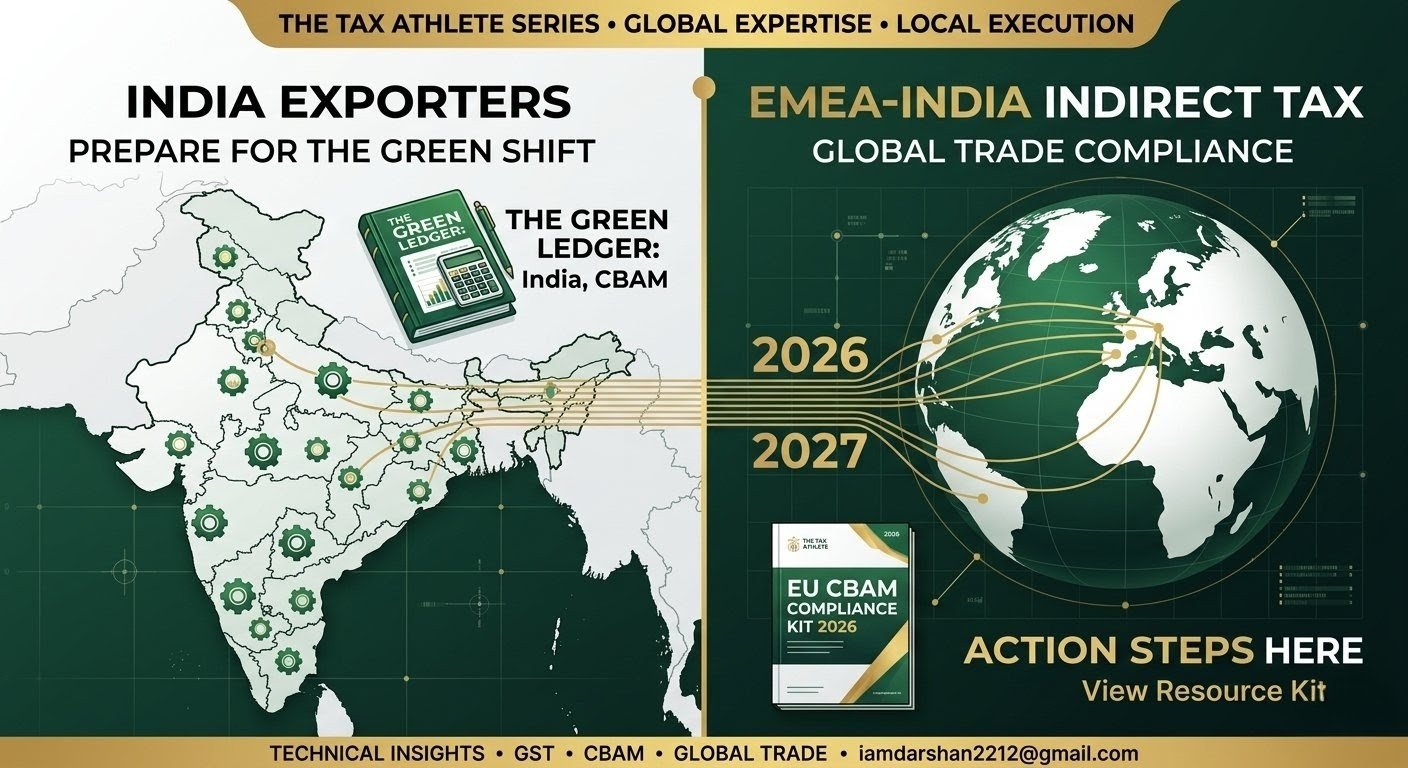
The Green Ledger: India, CBAM and the Carbon Tax Indian Exporters Are Already Liable For
The EU’s new carbon border mechanism is not a future threat. It is a current financial liability, and the data clock is already running.
In the last post, we looked at the IPL Income Ledger and traced how franchises build their commercial muscle, from the BCCI central pool to global licensing networks. Today, we are stepping off the cricket field and into the global industrial arena.
While most tax professionals in India are deep in GST reconciliations, a new heavyweight has entered the ring: the European Union. And it is not asking for a handshake. It is asking for a verified carbon audit trail.
The EU’s Carbon Border Adjustment Mechanism (CBAM) officially entered its definitive phase on 1 January 2026. If you export steel, aluminium, cement, or fertilisers to Europe, you are no longer just subject to customs duties. You are subject to a carbon price and that price is already being calculated, quarter by quarter, for every tonne of CO₂ embedded in their products.
For the Tax Athlete, this is the ultimate test of Regulatory Stamina. The certificates do not have to be purchased until February 2027 and surrendered by 30 September 2027. But the embedded emissions data that determines the final bill must be tracked, verified, and audited from right now, meaning this calendar year, 2026.
This is a 2027 payment problem built on a 2026 data problem. If the data is wrong, the bill gets bigger. If there is no data, EU authorities apply default values, the highest possible emission figures, and you pay the maximum rate.
Let us break this down from first principles.
1. The Heavy Lift: What Exactly Is CBAM?
Think of CBAM as a carbon equaliser at the EU border. Here is the problem it is designed to solve.
The EU has been running a domestic carbon pricing system for years: the Emissions Trading System, or EU ETS, where European manufacturers pay for every tonne of CO₂ they emit. This makes their products more expensive. If you are a German steel producer paying a carbon price, your steel costs more to make than steel from a country with no carbon rules at all.
So what happened? Production started shifting (or threatening to shift) to countries with weaker climate rules. The EU calls this “carbon leakage.” Their solution was CBAM: charge the same carbon price at the border that a European producer would have paid domestically.
CBAM currently covers six sectors: iron and steel, aluminium, cement, fertilisers, electricity, and hydrogen. These are the most carbon-intensive traded goods. India’s export mix overlaps heavily with this list. Iron and steel alone represent roughly 90% of India’s CBAM-exposed exports to the EU. Indian steel exports to the EU totalled approximately €4.2 billion in 2025.
This is not a future threat on the horizon. It is already in effect. The definitive phase started on 1 January 2026 and the EU confirmed the first quarterly CBAM certificate price: €75.36 per tonne of CO₂ on 7 April 2026. That is your number. That is the carbon price being applied to Q1 2026 imports right now.
2. The Compliance Timeline: Training Phase vs. Match Day
One of the most common mistakes Indian exporters are making right now is confusing the reporting timeline with the payment timeline. They are not the same thing.
Here is a clean breakdown of where we are and where we are headed.
There is also an important threshold to know. Importers whose total annual imports of CBAM-covered goods across all sectors fall below 50 tonnes per year are fully exempt from CBAM obligations. This replaced the old €150 per consignment threshold. If your EU importer is below this level, CBAM does not apply. Anything above it falls squarely inside the regime.
Professional Shortcut: If you need to move fast, you can skip the manual research and download the ready-to-use 2026 CBAM Compliance Kit here.
3. Why This Is an Indirect Tax Conversation, Not a CSR One
Let me be direct about this. Many business owners hear “carbon” and mentally file it under sustainability or corporate social responsibility. That is a dangerous misclassification.
CBAM is a trade and indirect tax mechanism. Here is why that matters to a CA or tax professional.
CBAM is verified at the point of import into the EU. Missing data or under-reported emissions can result in goods being held at the border or heavy penalties being applied (up to €100 per excess tonne of CO₂). This sits squarely in customs compliance territory.
Just as you audit a GST Input Tax Credit chain, you must now audit the Carbon Chain. The emissions profile of the electricity used in the factory, the carbon intensity of raw materials from sub-suppliers: all of it feeds into the CBAM calculation.
If a supply contract was signed in 2024 without a Carbon Clause, the Indian exporter may find their margins wiped out by the 2027 certificate cost. That is a live commercial liability sitting in existing contracts right now.
When reporting actual embedded emissions (rather than default values), third-party verification by an accredited verifier is now mandatory. On-site inspections are required in the first year of reporting, which is 2026. This is not self-declaration anymore.
The Global Trade Research Initiative estimates that Indian exporters who cannot document lower actual emissions may need to cut their EU prices by 15 to 22 percent to absorb the CBAM certificate cost and remain competitive. That is not a rounding error. That is a margin restructuring event.
And there is a compounding problem. If an Indian exporter uses EU default values because they do not have verified actual data, they pay the highest possible rate, because default values are benchmarked against the most emissions-intensive producers in the world, not against the actual performance of the factory. The EU has built a deliberate financial incentive to force accurate data collection. The penalty for not measuring is paying as if you are the worst emitter on the planet.
4. The Tax Athlete Strategy: How to Prep Your Clients
In my post on Progressive Overload and Tax Strategy, I made the case that athletes who compound their gains are the ones who do the boring, consistent foundational work first. CBAM compliance is exactly that kind of work. The foundations need to be laid now, in 2026, before the financial measurement window closes.
Here is what the transition from reactive to proactive looks like for you.
| Requirement | The Old Way (Transitional Phase) | The Tax Athlete Way (2026) |
|---|---|---|
| Emissions Data | EU Commission default values (highest possible rate) | Actual primary data collected from the factory floor, installation by installation |
| Verification | Self-declaration permitted | Third-party accredited verifier with on-site inspection for 2026: mandatory |
| Financial Provisions | No cost at all during transitional phase | Accruing a liability on the balance sheet now for 2027 certificate cost |
| Supply Chain | Only direct production emissions considered | Carbon footprint of inputs from sub-suppliers also mapped and documented |
| Contract Review | Not relevant; no financial exposure | All EU export contracts reviewed for Carbon Clause inclusion or renegotiation |
| CBAM Registry | Optional in transitional phase | Mandatory registration in the CBAM Registry for imports above 50 tonnes |
The Domestic Carbon Credit Angle
There is an important deduction mechanism worth knowing. If an Indian exporter or manufacturer can demonstrate that a verified carbon price has already been paid in India during production, that amount can be deducted from the CBAM certificate cost. India’s Carbon Credit Trading Scheme is still developing its credibility, but as it matures, this offset mechanism could significantly reduce the EU border tax bill for compliant Indian producers. This is a space worth watching closely and it is another reason why domestic carbon compliance infrastructure matters for international trade competitiveness, not just regulatory box-ticking.
5. The Opportunity: The Green Premium Sprint
While CBAM looks like a penalty, it is also a structural competitive advantage for manufacturers who move early. This is where the Tax Athlete mindset separates reactive businesses from proactive ones.
A manufacturer who invests in renewable energy (captive solar, wind power purchase agreements or green hydrogen for direct reduced iron production) will have measurably lower embedded emissions. Lower emissions means fewer CBAM certificates required. Fewer certificates means a lower carbon cost at the EU border. A lower carbon cost means a better price to the EU buyer or a higher margin, or both.
The EU is not just taxing carbon. It is pricing carbon into the competitive landscape. Indian manufacturers who decarbonise their production process do not just become compliant. They become cheaper to buy from. That is a first-mover advantage that compounds over time as the CBAM rate ratchets up through 2034.
As a Tax Athlete, the goal is not just to manage the tax liability. It is to optimise the underlying business so the tax itself shrinks. This is the same principle that applies to GST ITC optimisation: you do not just claim what arrives, you structure the supply chain to maximise what you are entitled to claim.
Indian steel producers are already moving in this direction, piloting hydrogen-ready direct reduced iron plants, expanding scrap-based electric arc furnace capacity and digitising emissions tracking. Aluminium manufacturers are increasing captive renewable energy through solar and wind power purchase agreements. Cement producers are lowering clinker ratios and investing in waste heat recovery. These are not CSR initiatives. These are CBAM cost reduction strategies that directly feed the bottom line of every EU export contract.
The Verdict: Start the Audit Now
The certificates are a 2027 problem. The data is a 2026 crisis. If you are not tracking your embedded emissions with the same precision you track your GST ITC, you are building a financial liability that you cannot see and that invisible liability is growing, every quarter, at €75.36 per tonne of CO₂.
Professional Shortcut: If you need to move fast, you can skip the manual research and download the ready-to-use 2026 CBAM Compliance Kit here.
The practical starting point is not complex. The starting point is to map which goods are CBAM-covered, verify whether the EU importer is registered as an authorised CBAM Declarant. Establish what emissions data is currently being collected at the factory level. Find out whether any sub-suppliers to those factories are also inside the carbon chain. Review existing contracts for carbon clauses. Begin accruing a provisional liability on the balance sheet using the Q1 2026 price of €75.36/tonne as a baseline estimate.
None of these steps require expertise in climate science. They require the same rigour you bring to any complex indirect tax audit: methodical, documented, and started early enough to course-correct before the measurement window closes.
The EU is not going to wait. The clock started on 1 January 2026. And the first annual report covering every shipment sent this year will be due by 30 September 2027. That deadline is closer than it sounds.
The Digital Cardio: E-Invoicing Rollouts Across EMEA and What They Mean for Real-Time Compliance
From carbon borders to digital borders. Poland’s KSeF, Belgium’s mandatory Peppol framework, and a wave of EMEA e-invoicing mandates are changing how transactions are reported in real time, not retrospectively. We will break down the architecture of this shift, why it matters for Indian businesses with EU operations, and what “continuous transaction controls” mean for the future of indirect tax compliance.
Verified Sources & References
- European Commission: CBAM Official Portal (DG TAXUD)
- S&P Global: Q1 2026 CBAM Certificate Price Confirmed at €75.36 (7 April 2026)
- EY Global: EU Adopts CBAM Omnibus Regulation (October 2025)
- International Carbon Action Partnership: CBAM Simplification Rules
- CSEP: Distributional Implications of EU CBAM on India (2025)
- World Bank: Measuring Developing Country Exposure to EU CBAM
- ESG Times: EU CBAM Impact on Indian Exports (April 2026)
- Reed Smith: CBAM Simplification: What You Need to Know
Disclaimer: This post is for educational and informational purposes only. CBAM regulations are subject to frequent updates, delegated acts, and national interpretations within EU member states. Certificate price figures are based on official European Commission publications as of April 2026. Financial impact estimates are derived from publicly available research and are illustrative only. Please consult a specialised trade compliance and environmental tax advisor for specific compliance strategies relevant to your client’s situation.
Secure & Instant: Payment is processed via Razorpay with bank-grade encryption. The download link is delivered immediately on successful payment — no email wait, no account required.
Get the CBAM Compliance Kit
Stop stressing over the €75.36/tonne liability. Get the ready-to-use kit for Indian exporters including the Emissions Calculator, September 2027 Roadmap, and Buyer Templates.
Secure Payment via Razorpay (UPI, Card, Netbanking)
Instant PDF Delivery to your Email