The Warm-Up: Where We Left Off
Last week, we stepped off the cricket pitch and walked into the global arena.
We tracked how two Indian ships — MT Shivalik and MT Nanda Devi — carried over 92,000 metric tonnes of cooking gas through a six-mile war zone corridor, while the Indian Navy kept watch overhead. We saw how years of quiet planning, shifting where India buys its oil is now protecting us better than almost any other country in the world.
But here is the thing. The global crisis didn’t stay global.
It walked straight into your business. Into your freight bills. Into your raw material costs. Into your profit margins.
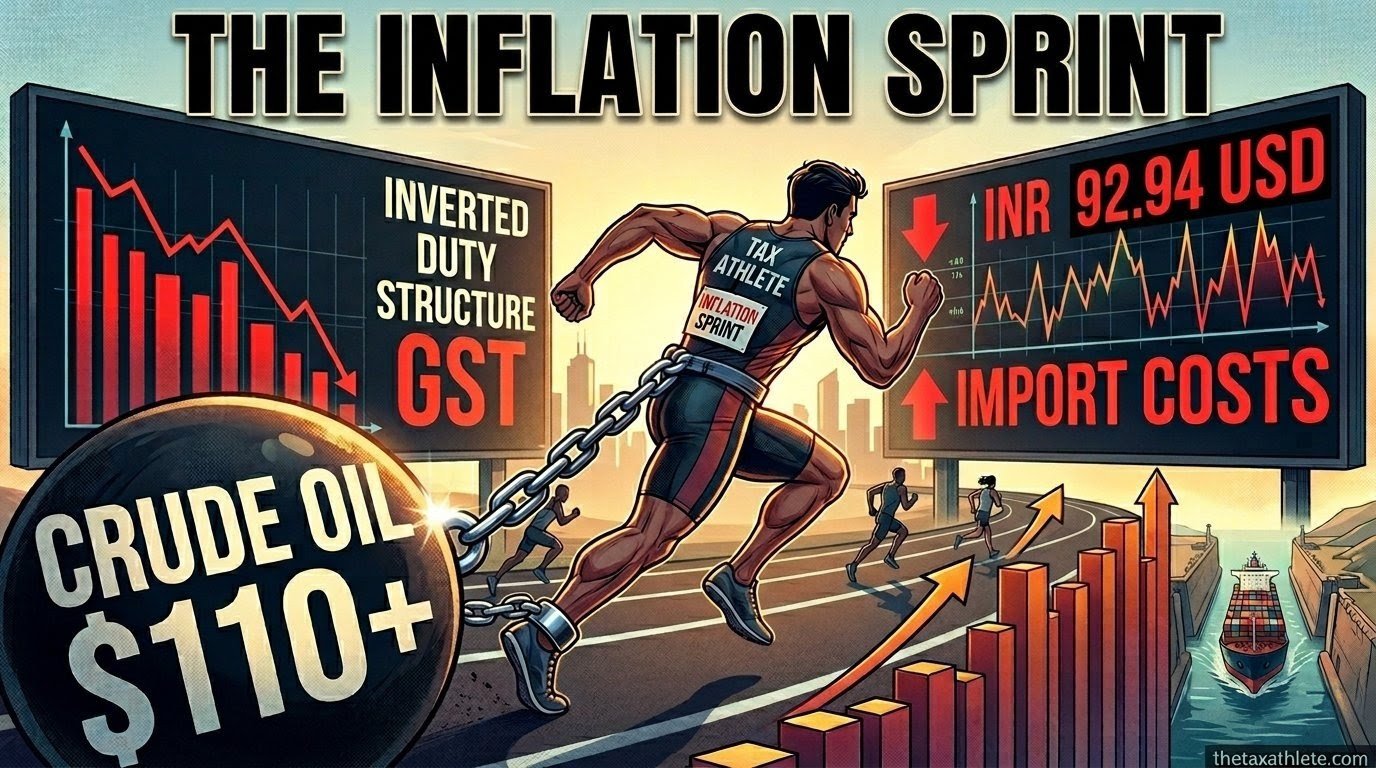
Brent Crude has been trading between $100–$110 per barrel through March 2026, briefly touching $110+ earlier this week before easing, still roughly $32 above where it was a year ago. The Indian Rupee has weakened past ₹94 against the US Dollar as of March 26, 2026, touching an all-time low and down nearly 10% over the last 12 months.
Early signals of diplomatic progress have eased prices slightly, but as any athlete knows, you don’t stop your sprint training because the weather looks better. The structural pressure on your cost sheet is already here.
We are no longer jogging through a tough market. We are in a full Inflation Sprint.
Every serious runner knows the difference. In a jog, you can slow down, fix your form, catch your breath. In a sprint, every second counts. Your technique either holds under pressure or it breaks. There is no middle ground.
The Finance Bill 2026 is your sprint technique manual. Let me walk you through it in plain English.
Section 1: The Hormuz Factor — Why Your Costs Are Going Up Even If You Don’t Sell Oil
For: Every business — whether you make things, trade things, or provide services.
Here is something most business owners don’t realise: even if your company has absolutely nothing to do with oil or gas, you are still paying for the Hormuz crisis right now.
How? Because oil is the hidden ingredient in almost everything.
When fuel costs go up, trucks cost more to run. When trucks cost more to run, freight charges go up. When freight charges go up, your supplier charges you more. When your supplier charges you more, your costs go up even if you never bought a single drop of oil yourself.
This is called cost-push inflation and right now, it is running at full sprint.
On March 7, 2026, the price of a household LPG cylinder went up by ₹60 in a single day. That happened because 80–90% of India’s imported cooking gas travels through that same six-mile Hormuz corridor. When that route gets disrupted, the shock travels all the way to your kitchen and your factory floor.
What you can do right now: Think of your business like a relay team. If one runner is slow, the whole team loses time. Do a quick “Energy Audit” of your supply chain this week:
- Which of your suppliers depend on long-distance road or sea transport?
- Are any of your raw materials coming from Gulf-region suppliers?
- Are you absorbing rising fuel surcharges quietly, without passing them on to customers?
Finding these answers now, before they show up as losses on your books is the difference between running a smart sprint and stumbling at the first corner.
Section 2: The Finance Bill 2026 — Five Rules That Can Save Your Margins
Think of the Finance Bill 2026 as your sprint coach handing you a technique manual right before the race starts. It won’t slow down the inflation around you. But if you follow it correctly, your form will hold when others are breaking down.
Here are the five amendments that matter most for your business right now.
A. Giving Discounts After a Sale Just Got Much Easier
For: Businesses that offer discounts, price corrections, or loyalty rebates to their customers.
Imagine this situation. You sold goods to a long-term customer at ₹100 per unit in January. By March, your costs had changed so much that to keep the contract, you needed to give them a ₹10 discount retroactively, on goods already sold.
Under the old GST rules, this was a compliance nightmare. You needed a written agreement before the sale to claim any tax benefit on that post-sale discount. Most businesses did not have that. So they either ate the discount cost or lost the customer.
As I explained in detail in my earlier post on post-sale discount rules, this was one of the most frustrating pain points in GST compliance.
The fix: Changes to Sections 15 and 34 of the CGST Act now allow you to issue a credit note. A formal adjustment document for discounts given after the sale, even without a prior written agreement. The only condition is that your buyer reverses the Input Tax Credit they claimed on the original purchase.
In plain English: You no longer pay GST on money you never actually received. In a market where prices are changing week to week, this gives you the flexibility to keep your customers without getting punished on your tax bill. In sprint terms — you can adjust your stride mid-race without losing your rhythm.
B. Getting Your GST Refund Faster — Because Cash Is Oxygen
For: Manufacturers and businesses where the tax on your raw materials is higher than the tax on your finished product.
Here is a situation that thousands of Indian manufacturers face every day.
You buy raw materials and pay 18% GST on them. But the product you make from those materials is taxed at only 12% when you sell it. That means you are consistently paying more tax going in than you collect going out. The government owes you a refund but getting it used to take months of paperwork, follow-ups and waiting.
Running a business while waiting for a large GST refund is like trying to sprint while someone is holding your shirt from behind. You are working hard but going nowhere fast.
As I covered in my post on why manufacturers can finally stop chasing their own GST refunds, this has been one of the biggest working capital killers for domestic businesses.
The fix: An amendment to Section 54(6) now allows businesses in this situation, called an Inverted Duty Structure, to receive 90% of their refund almost immediately, as a provisional payment while the full verification happens in the background.
In plain English: Instead of waiting 6–9 months for your full refund, you get 90% of it upfront. In a ₹100/barrel world where every rupee of working capital matters, this is not a minor administrative change. This is oxygen mid-sprint. If you think you qualify, call your CA this week not next month.
C. The GST on Your Freight Bills — You are Probably Leaving Money Behind
For: Any business that pays for logistics, warehousing, or packaging which in this environment is nearly everyone.
This is the section most businesses skip. It is also the one where most businesses are quietly losing thousands of rupees every month without realising it.
Here is how it works. Every time you pay a transporter to move your goods, you pay 18% GST on that freight bill. That GST is fully claimable as Input Tax Credit, meaning you can use it to reduce your overall GST payment. The government is essentially giving you that money back.
But there is a catch. Your transporter has to upload their invoice correctly for it to appear in your GSTR-2B, the government’s official record of the credits you are entitled to. If they don’t file on time, or file incorrectly, that credit simply disappears and most businesses don’t even notice.
Here is what that looks like in real rupees: If your monthly freight bill is ₹5 lakh, the ITC you are entitled to claim is ₹90,000 every single month. That is ₹10.8 lakh every year, sitting unclaimed if your transporters are not compliant.
Think of it like this. Two sprinters are running the same race. One is wearing proper running shoes. The other is wearing shoes with a slow leak in the sole, losing energy with every step, not even aware it’s happening. Unclaimed ITC is that slow leak.
The fix: This week, open your GSTR-2B and check whether your top logistics vendors’ invoices are showing up. If they are not, follow up with those vendors directly. Your vendor’s compliance failure is your cash flow problem — and in a sprint, you cannot afford to carry dead weight.
D. MAT Credit — Use It Before the Clock Runs Out
For: Companies still on the older corporate tax structure that have been accumulating MAT credit over the years.
This one requires a little background. Some companies, particularly those with high book profits but lower taxable income pay something called Minimum Alternate Tax (MAT). When you pay MAT, you accumulate credits that can be used to reduce your tax bill in future years.
Under the Finance Bill 2026, two things are changing. First, the MAT rate is dropping from 15% to 14% (go to section 206, page 47) giving you immediate relief. Second, and more importantly from April 1, 2026, no new MAT credits will accumulate.
Think of your MAT credit balance like a water bottle you filled up during training. On April 1, the tap turns off permanently. Whatever is in the bottle is all you get. Under Section 115JAA of the Income Tax Act, you can use up to 25% of that balance every year to offset your current tax liability.
A sprinter who forgets their water bottle at the start line does not get a second chance mid-race.
What to do right now: Log into the Income Tax Portal and check your ITR-6 to see your current MAT credit balance. Then ask your CA to plan how much you should be utilising before the April 1 cutoff. This is a use-it-or-lose-it situation.
E. Billing International Clients? Here is Your Protection Against a Transfer Pricing Audit
For: IT companies, consultants, and any business that provides services to clients outside India and bills in foreign currency.
With the Rupee at ₹94, every dollar you earn from a foreign client is worth more in rupees than it was six months ago. That sounds like good news and for your revenue, it is.
But it also means the tax department pays closer attention. When your margins look unusually high because of a weak rupee, transfer pricing auditors can question whether your pricing is genuine or artificially inflated.
This is the equivalent of a sprinter being pulled aside mid-race for a random check. Even if you have done nothing wrong, the disruption costs you time, money, and energy.
The change: The 2026 Budget has reduced the Safe Harbour margin for IT and technical services under Rule 10TD of the Income Tax Rules from a range of 17–24% down to a flat 15.5%. Equally important is that the Finance Bill 2026 has raised the eligibility threshold for Safe Harbour from ₹300 crore to ₹2,000 crore in international transactions. This means thousands of mid-sized IT and technical service companies that were previously too large to qualify can now claim Safe Harbour protection for the first time. You can verify the updated thresholds on the CBDT’s transfer pricing guidance page.
In plain English, what Safe Harbour actually means: The tax department is saying: “If your operating profit margin is at least 15.5% on your international contracts, we will not question your pricing.” That’s your protected lane on the track. Stay in it and no one pulls you aside.
The lower threshold gives you more room to absorb currency driven margin fluctuations, salary hike cycles, project overruns, new hires without crossing into audit territory. Especially useful in a quarter where a weak rupee is already making your margins look inflated on paper.
If you have not reviewed your Safe Harbour eligibility before March 31, make that call to your transfer pricing consultant this week. The financial year finish line is closer than it looks.
Section 3: The Rupee at 94 — How to Lock In Your Import Costs Before They Get Worse
For: Any business importing raw materials, machinery, or components priced in US Dollars or Euros.
If you import anything — raw materials, machinery, components, packaging — the Rupee at ₹94 is not just a news headline. It is a cost increase sitting on your next purchase order.
In my Progressive Overload post, I wrote about the kind of preparation that protects you when external conditions turn unpredictable. For importers right now, that preparation has a specific name: a Forward Contract.
Here is exactly what it means and how it works.
A Forward Contract is an agreement with your bank to buy US Dollars (or any foreign currency) at today’s exchange rate, for a payment you will make in the future. You agree on the rate today, ₹94 and the bank holds that rate for you for 30, 60, or 90 days, depending on when your payment is due.
Here is the real-world impact: Say you are importing goods worth ₹50 lakh next quarter, priced in USD. If you lock in today’s rate of ₹94 and the Rupee weakens to ₹95 next month, which is a real possibility if the Hormuz situation gets worse, you pay nothing extra. Your cost is fixed. You have already won that leg of the race before it even started.
If the Rupee strengthens instead, you lose very little. The insurance cost of a forward contract is far smaller than the potential loss from an unhedged currency swing.
What to do: Call your bank’s treasury desk and ask specifically for a “USD/INR forward cover” on your next import payment. Come prepared with the amount you expect to import in the next 90 days. That one 30 minute conversation could save you more than any other action on this list.
A sprinter does not choose their starting position after the gun fires. Lock your rate now, while you still control your lane.
The Cool-Down: 5 Things to Do This Week
Good sprinters do not stop the moment they cross the finish line. They cool down properly, locking in the gains and preventing injury. Here is your five-point checklist, specific to this week and this crisis:
- Map your Gulf-exposed vendors — Identify which of your top 5 suppliers or logistics partners depend on Hormuz-region freight routes. Start a backup supplier conversation before April. Do not wait for the disruption to find you.
- Open your GSTR-2B today — Add up the ITC you are entitled to claim on freight, warehousing, and packaging. If the number surprises you, your vendor compliance audit starts tomorrow morning.
- Call your CA this week about Section 54 — If you are in an inverted duty structure, ask specifically: “Do I qualify for the 90% Provisional Refund?” This is not a next quarter conversation. Cash now beats cash later in a sprint.
- Check your MAT credit balance on the Income Tax Portal — Log into your ITR-6, find your balance, and ask your CA how much you should be using before April 1, 2026. The tap turns off. Whatever is in the bottle is all you get.
- Book 30 minutes with your bank’s treasury desk — Ask for a USD/INR forward cover on your next import payment cycle. Come with your expected import value for the next 90 days. This is the single highest-impact financial conversation you can have this month.
The Strait of Hormuz crisis reminded us that the world can change in a six-mile corridor. India adapted with strategy, diplomacy, and speed. Your business can run the same race but only if your form is right before the gun fires.
Up Next
India’s GST system is not just being reformed, it is being completely rebuilt from scratch. Next week, we decode the GST 2.0 rate rationalisation and whether your business category is moving into a “fat-burning” lower tax bracket or bracing for a heavier load at the top.
Stay in the Game
If this gave you clarity, subscribe to The Tax Athlete newsletter — no spam, just high precision GST and current affairs analysis delivered before the market moves.
Catching up on the series? Start with the Strait of Hormuz post or go back to where the Finance Bill 2026 story began with the Post-Sale Discount Game Changer.
Disclaimer: This post is for educational purposes only and does not constitute professional tax, legal, or financial advice. Laws are subject to change. Please consult a qualified GST practitioner before making decisions based on this content. The Tax Athlete is not liable for any losses resulting from use of this information.