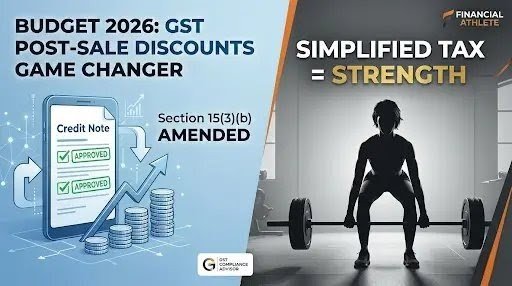
The Hook: Defeating the Compliance Hydra
In the complex, high-stakes world of Indirect Tax, we’ve spent years fighting what I call the “Hydra” of post-sale discounts. Historically, if a business wanted to offer a discount after the initial sale was made, the GST Department required a mountain of evidence. You had to jump through rigorous, bureaucratic hoops just to claim the tax deduction you were legally owed.If you didn’t have a rigid, pre-existing written agreement, or if you couldn’t precisely link every single rupee of a discount credit note back to a specific original invoice, your compliance record was in jeopardy.But as of the February 2026 Union Budget, presented by the Finance Ministry, the rules of the game have finally changed. The government is executing a significant pivot—moving away from a system of constant suspicion toward a “trust-based” compliance model.
The Meat: The 12-Year Perspective on What Actually Changed
For nearly a decade, a single sub-clause was the source of immense business friction: Section 15(3)(b) (The Section can be found under Clause 137 on page 218 of the Finance Bill) of the CGST Act. It essentially mandated: “You can only deduct a post-sale discount from your taxable value if it was agreed upon BEFORE the sale, AND you can point to the exact invoice it belongs to.”The Budget 2026 Substitution:The government has completely substituted Section 15(3)(b), fundamentally restructuring the logic. The two biggest bureaucratic hurdles have been demolished:No Pre-Supply Agreement Required: The rigid requirement for a signed contract on day one, just to validate a loyalty or target discount given on day 100, is gone.End of Invoice-Wise Linkage: Businesses are no longer required to laboriously map a single bulk credit note to hundreds or thousands of individual historical invoices. The focus has rightly shifted to the commercial substance of the transaction.
A Massive Win for Ease of Doing Business (FMCG and Pharma)
This change is an overwhelming victory for sectors like FMCG (Fast-Moving Consumer Goods) or Pharmaceuticals, where complex distribution networks thrive on volume-based incentives. A dealer might only be entitled to a 5% “Year-End Target” discount if they cross a certain threshold by December.Calculating and linking that 5% discount to every single invoice issued between April and December was an administrative nightmare. Now, the process is streamlined: issue a valid Credit Note under Section 34 (The amendment to Section 34(2) can be found under Clause 138 on page 218 of the Finance Bill) when the target is met, and ensure the recipient reverses their Corresponding Input Tax Credit (ITC). The government’s goal is to simplify, not complicate.
Expert Pro-Tip for the Audit Trail: Relaxation of the law must not be confused with laziness. While the legal barrier is lowered, you must ensure your ERP systems (like SAP, Oracle, or Tally) are configured to maintain a clear digital trail. The GST Department may not ask for the initial agreement upfront anymore, but they will verify that the Input Tax Credit (ITC) reversal was properly handled by your buyers. Internal data clarity remains your best audit defense.
The “Tax-Athlete” Connection: Where Simplification Means Strength
This simplification narrative isn’t just happening in tax legislation; it’s the exact same philosophy I apply to my morning gym sessions. For years, I chased complexity with isolated exercises. Now, I’ve intentionally shifted my focus to heavy compound movements—squats, presses, and pulls—that provide the absolute highest ROI (Return on Investment) for my limited time.In both tax compliance and fitness, “simplification” isn’t about doing less—it’s about doing what matters most, more effectively. By removing the bureaucratic “fluff” of invoice-linking, the government is letting businesses focus their energy on core growth. Similarly, by focusing on my main lifts, I’m building a stronger foundation without wasting hours on junk-volume exercises that burn me out. It’s about maximizing efficiency for maximum gain.
The Closing: A Leaner Compliance Era Begins
This Budget is a powerful breath of fresh air for compliance managers across India. It marks a sincere effort to align our tax laws with the commercial reality of how modern business operates. You can read the official explanatory notes and legal circulars regarding these changes on the official India Budget portal. But while the law is getting leaner and more efficient, your physical and mental discipline should be getting stronger. Next week, I’m going to share a surprising secret from my toolkit: why a structured 5-day gym routine is actually my most productive tax strategy for staying focused during the intense pressure of audit season. See you then!
Disclaimer: Tax laws are complex and subjective. The information above is for educational purposes and reflects the specific changes in the (hypothetical) Budget 2026 scenario. Always consult a qualified tax professional before making significant compliance changes.