Warm-Up: This post is part of The Tax Athlete’s EU Power Play Series. If you are new here, start with the full overview in EU ViDA Explained: The Three Pillars Reshaping VAT in Europe. For the surveillance side of this story, read how CESOP is tracking every cross-border payment and how DAC7 and DAC8 are pulling Indian sellers into the EU reporting net.
Picture a logistics coordinator at a manufacturer in Pune. Their European distributor sits in Rotterdam. For the last four years, the team has been shipping finished goods directly to a dedicated warehouse in Germany, waiting for the German buyer to pull stock from the shelves. No German VAT registration required. No local filings. Clean, efficient, and entirely legal under a specific EU rule called the Call-Off Stock Simplification.
That rule is now on a countdown timer.
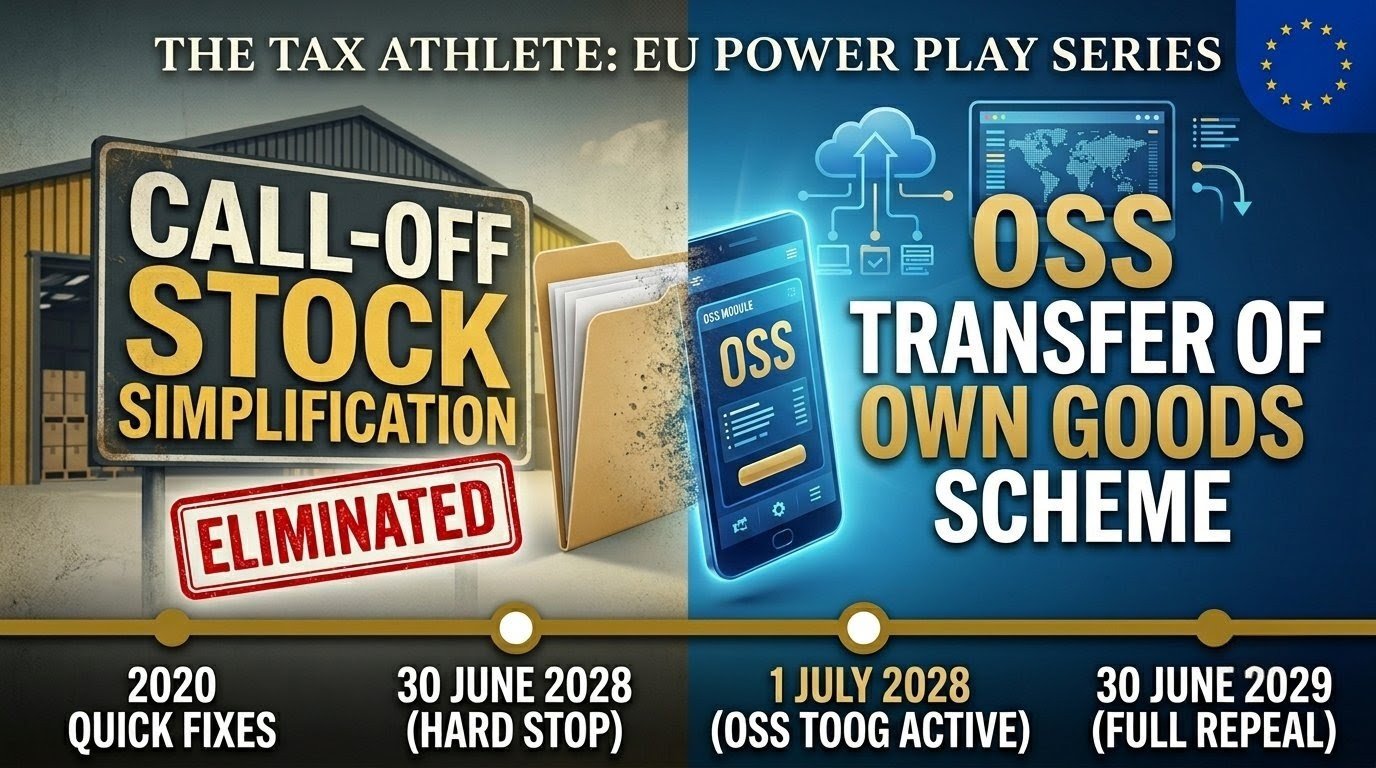
Under the VAT in the Digital Age (ViDA) reform package — adopted by the European Council on 11 March 2025 and published in the Official Journal of the EU on 25 March 2025 — the call-off stock simplification is being phased out permanently. A new digital framework takes its place. The hard stops are 30 June 2028 and 30 June 2029.
If your business moves inventory across European borders, this change affects your warehousing strategy, your ERP architecture, your contracts, and your cash flow. Here is exactly what is changing, what replaces it, and the four-step playbook your team needs before the deadlines arrive.
What Was the Call-Off Stock Rule, and Why Did It Matter?
Think of the Call-Off Stock rule as a loyalty card for cross-border inventory logistics. Under the normal EU VAT rules, moving your own goods across a border counts as an Intra-Community Supply in the country you are leaving and an Intra-Community Acquisition (ICA) in the country you are entering. That acquisition typically triggers a VAT registration obligation in the destination country — even though you have not sold anything yet.
The Call-Off Stock Simplification, introduced as part of the EU’s 2020 “Quick Fixes” and codified in Article 17a of the VAT Directive, created a narrow but useful exception. It said: if you move goods to another EU country for a specific, pre-identified VAT-registered customer, and that customer takes ownership within 12 months, the initial cross-border movement is treated as a non-event for VAT purposes. No acquisition to report. No local VAT registration needed in the destination country.
The conditions were strict. The customer had to be identified before the goods crossed the border. The goods had to be stored in a warehouse designated for that customer. The ownership transfer had to happen within the 12-month window. Speculation was not permitted. But for supply chains that met those conditions, it was a genuinely useful administrative shortcut.
Why was it not universal? The simplification only applied when a specific buyer was waiting for the goods. If you were shipping inventory speculatively to a fulfilment centre in Poland to serve whoever ordered next, you were outside the scope of the rule entirely — and required a Polish VAT registration from day one. Many businesses running consignment models were exposed to non-compliance without realising it.
The ViDA Elimination Timeline: Two Hard Deadlines
The ViDA legislative package replaces the call-off stock simplification with a broader digital alternative. The phase-out follows a strict two-date sequence confirmed in Council Directive (EU) 2025/516:
Call-Off Stock Phase-Out: The Official Countdown
The practical message is simple: from 1 July 2028, the only tool available for tax-neutral cross-border inventory movements is the new OSS scheme. Any business that misses this transition faces unexpected VAT registration obligations across multiple EU Member States simultaneously.
The Reporting Difference: Call-Off Stock vs OSS TOOG, Step by Step
This is the most important mechanical section in the post. The two regimes produce very different reporting sequences for the same physical scenario. Getting this wrong — in your ERP coding, your contracts, or your compliance calendar — is where real exposure lives. Here is the full comparison.
The scenario throughout: a German supplier ships goods to a dedicated warehouse in Poland for a specific Polish VAT-registered buyer.
Before Article 17a (Pre-2020 Default and Post-June 2029 Default Without OSS TOOG)
Without any simplification, the default EU VAT rules apply the following three-step sequence:
Step 1 — Border crossing: The supplier is deemed to make a deemed ICS (Intra-Community Supply) in Germany, reported at 0% on the German VAT return and in the EC Sales List with the supplier’s own Polish VAT number as the counterparty. Simultaneously, a deemed ICA (Intra-Community Acquisition) of own goods is recorded in Poland — which requires the supplier to hold a Polish VAT registration to report this self-acquisition.
Step 2 — Goods sit in the warehouse: The supplier is effectively holding its own VAT-registered inventory in Poland. Intrastat arrivals must be reported in Poland.
Step 3 — Buyer calls the goods: The supplier records a domestic supply in Poland on its Polish VAT return. The buyer pays Polish VAT on that supply or accounts for it under reverse charge if applicable. The supplier must have a Polish VAT registration to handle this leg.
This is the full compliance burden the call-off stock rule was designed to eliminate.
Under Article 17a Call-Off Stock (2020 to 30 June 2028)
When all conditions are met, the entire border-crossing leg is deferred:
Step 1 — Border crossing: Non-event for VAT purposes. Nothing is reported by the supplier or the buyer. The goods cross into Poland invisibly for VAT. The supplier maintains a call-off stock register and includes the buyer’s VAT number in the recapitulative statement, but no ICS or ICA is recorded at this stage. Intrastat dispatches are still required from Germany.
Step 2 — Goods sit in the warehouse: The clock runs. The buyer must call the goods within 12 months of arrival.
Step 3 — Buyer calls the goods: This is the moment the transaction comes into existence. The supplier records an exempt ICS in Germany at 0% on the German VAT return and in the EC Sales List. The Polish buyer simultaneously records an ICA in Poland on its own Polish VAT return and self-assesses Polish VAT under the reverse charge. The supplier needs no Polish VAT registration at any stage. There is no domestic supply leg. The ICS and ICA together cover the entire transaction in one step.
Key point: Under call-off stock, there is no domestic supply in the destination country. The ICS and ICA are the entire transaction. The border crossing and the title transfer to the buyer are treated as a single intra-Community event occurring at the moment of call-off.
Under OSS TOOG (From 1 July 2028)
The TOOG scheme splits what call-off stock kept as one event into two distinct legs, each with its own treatment:
Step 1 — Border crossing: The supplier reports the physical movement of goods in the monthly OSS return filed in the Member State of identification (Germany in this scenario). The ICA of own goods in Poland is treated as VAT-exempt under the OSS scheme. No Polish VAT registration is required for this leg. Intrastat arrivals in Poland must still be reported separately — the OSS return does not replace statistical reporting obligations.
Step 2 — Goods sit in the warehouse: The goods are now the supplier’s inventory sitting in Poland, with the cross-border movement already accounted for. There is no 12-month clock. The commercial arrangement with the buyer continues on whatever terms the contract specifies.
Step 3 — Buyer calls the goods: When the buyer takes the goods, the supplier makes a domestic supply in Poland. This is the default EU VAT treatment that Article 17a call-off stock was specifically designed to eliminate. Under TOOG, this leg reverts to that pre-2020 default. However, because the cross-border movement has already been handled separately via the OSS return, and because the mandatory domestic reverse charge under ViDA (Article 194, mandatory from 1 July 2028) applies to all B2B supplies by non-established, non-registered suppliers to VAT-registered buyers, the Polish buyer self-assesses Polish VAT. The supplier does not charge Polish VAT and still needs no Polish VAT registration for this leg.
The critical structural difference from call-off stock: Under Article 17a, the call-off stock regime collapsed the border crossing and the sale to the buyer into a single intra-Community event — an exempt ICS by the supplier and an ICA by the buyer — at the moment of call-off. There was no domestic supply leg at all. Under TOOG, these are two entirely separate events: the border crossing (reported via OSS, ICA VAT-exempt) and the subsequent sale to the buyer (a domestic supply, covered by mandatory reverse charge). The end result — no local VAT registration required — is the same. But the transaction coding, the invoice type issued to the buyer, and the reporting path are fundamentally different, and ERP systems and contract templates must reflect this.
| Event | Pre-2020 Default (No Simplification) | Call-Off Stock Article 17a (2020–2028) | OSS TOOG (From 1 July 2028) |
|---|---|---|---|
| Border crossing | Deemed ICS in departure country + deemed ICA of own goods in destination country. Local VAT registration required in destination. | Non-event. Nothing reported. Call-off stock register maintained. Buyer VAT number in recapitulative statement. | Reported in monthly OSS return. ICA in destination country is VAT-exempt. No local registration needed. |
| Intrastat | Dispatches from departure country. Arrivals in destination country (on supplier’s local return). | Dispatches from departure country. No arrival Intrastat by supplier (no local registration). | Dispatches from departure country. Arrivals in destination country must still be reported separately. OSS does not replace Intrastat. |
| Buyer calls the goods | Domestic supply in destination country on supplier’s local VAT return. Buyer pays or reverse-charges local VAT. | Exempt ICS reported in departure country VAT return and EC Sales List. Buyer records ICA in destination country. No domestic supply. No local registration for supplier. | Domestic supply in destination country. Covered by mandatory reverse charge (Article 194) — buyer self-assesses. Supplier needs no local registration. |
| EC Sales List / Recapitulative Statement | ICS reported with supplier’s own VAT number in destination country as counterparty. | Buyer’s VAT number reported in recapitulative statement during the storage period. ICS reported when buyer calls goods. | Stock movements reported in OSS return only. Not included in EC Sales List. From 1 July 2030, mandatory reverse charge supplies reported in Digital Reporting Requirements (DRR). |
| Local VAT registration in destination country | Required. | Not required (if all conditions met). | Not required for either the movement leg or the domestic supply leg (reverse charge covers the sale). |
Why the Reverse Charge Covers the Sale Leg — but Not the Movement Leg
This is the point that causes the most confusion, so it is worth stating precisely.
Under OSS TOOG, there are two distinct events. The border crossing — the physical movement of the supplier’s own goods — is handled by the OSS return. The reverse charge cannot apply here because there is no buyer and no sale at the moment of crossing. The reverse charge requires a transaction between two parties, and a supplier moving its own stock is a single-party event.
The sale to the buyer when the goods are called off is a separate event entirely. Because the cross-border movement has already been reported via OSS, the sale is a domestic supply in the destination country — not an intra-Community transaction. Here, the mandatory domestic reverse charge under ViDA (Article 194) applies: the supplier is non-established and not VAT-registered in the destination country, the buyer is VAT-registered there, and the supply is B2B and taxable. The buyer self-assesses the local VAT on their own VAT return. The supplier issues an invoice without local VAT, citing the reverse charge obligation, and needs no local registration for this leg.
The rule of thumb: OSS handles the movement. The reverse charge handles the sale. Neither can substitute for the other. The reverse charge cannot apply to the movement leg because there is no buyer at the moment of border crossing — the reverse charge requires a two-party transaction. The OSS cannot handle the sale leg — it is a declaration portal for stock movements only, not a mechanism for reporting B2B sales. Both tools working together is what allows OSS TOOG to deliver full compliance without any local VAT registration in the destination country.
The Replacement: OSS Transfer of Own Goods (TOOG) Scheme
To fill the gap left by the call-off stock elimination, ViDA’s SVR pillar introduces a dedicated new module within the existing Union One-Stop Shop (OSS) portal. Effective 1 July 2028, businesses can report all cross-border movements of their own stock through a single monthly OSS return filed in their Member State of identification — typically the country where they are established.
Under this scheme, the Intra-Community Acquisition in the destination Member State is treated as VAT-exempt. The business does not need to obtain a local VAT number in France, Poland, Spain, or Italy simply to hold inventory there. One return, one portal, one filing obligation covers all qualifying stock movements across the EU.
There are important conditions attached. The scheme cannot be used for goods on which the business does not have a full right to VAT deduction in the destination Member State. It also does not remove the obligation to file Intrastat statistical returns — those reporting requirements for physical goods movements remain in place separately, as confirmed by the EU Commission. Businesses should not conflate VAT compliance simplification with statistical reporting relief.
Who qualifies as the Member State of identification? For EU-established businesses, it is the country where the business is established. For non-EU businesses moving goods between EU Member States, it is the Member State from which the first dispatch originates.
The Trade-Off: Input VAT Recovery and Working Capital
The OSS TOOG scheme delivers a real administrative simplification. But it introduces one structural trade-off that finance teams must model carefully before committing to it: input VAT recovery.
An OSS return is a declaration portal. You report stock movements and output tax obligations through it. You cannot claim back input VAT on it. If your business incurs local VAT costs in destination countries — warehousing fees charged by a third-party logistics provider (3PL), domestic freight charges, local handling fees, or import VAT at a port of entry — those costs cannot be reclaimed on your monthly OSS filing.
To recover that input VAT, you must use one of two separate refund routes:
The 8th Directive Refund Process applies to businesses established within the EU but not VAT-registered in the country where the costs arose. The 13th Directive Refund Process applies to businesses established outside the EU entirely. Both processes work, but they operate on longer timelines than a standard domestic VAT return cycle. For high-volume operations with significant warehousing and logistics spend in multiple EU countries, this delay creates working capital drag that must be factored into treasury planning.
| Strategy | Compliance Complexity | Input VAT Recovery | Best For |
|---|---|---|---|
| OSS TOOG Scheme | Low. Single monthly return from one Member State of identification. No local registrations for stock movements. | Via 8th or 13th Directive refund portals. Refund timeline is longer than a local VAT return. | Mid-market businesses and enterprises with low local overhead, clean high-velocity distribution lanes, and limited 3PL spend in destination countries. |
| Local VAT Registration | Higher. Requires maintaining individual VAT numbers and filing local returns in each country. | Deducted directly on the local VAT return. Faster working capital recovery. | High-volume enterprises with substantial warehousing, processing, or 3PL costs in specific EU countries where the cash-flow savings outweigh the registration and compliance costs. |
The right answer is not one or the other universally. It is a country-by-country calculation, which is exactly what the four-step playbook below is designed to guide.
Four-Step Playbook for Supply Chain and Tax Teams
The 2028 deadline is close enough that preparation needs to begin now. The following four steps mirror how a well-structured sports team would prepare for a rule change mid-season: audit your current position, analyse your options, upgrade your systems, and update your contracts before the whistle blows.
Execute a Comprehensive Inventory Lane Audit
Map every cross-border supply chain lane your business operated over the last 24 months. Isolate which flows currently rely on the call-off stock simplification under Article 17a. Identify where your inventory sits, which lanes have pre-determined buyers, and which lanes are speculative or consignment-based.
Compliance BenefitThis audit will often surface what practitioners call “accidental consignment” — situations where stock is stored in a destination country without a pre-identified buyer and without a local VAT registration. If your audit uncovers this, you have the chance to remediate it now, before a tax authority does it for you through an audit penalty.
Cash Flow BenefitBy mapping lanes over 24 months, you can calculate the exact volume of input VAT tied up in local 3PL fees and freight per country. A lane from Germany to Poland with high local overhead costs signals that the OSS route will trap working capital in the slower 13th Directive process — and that a direct Polish VAT registration may actually be the smarter financial choice.
Run the Binary Footprint Analysis Country by Country
For each EU country where your business holds inventory, place it into one of two buckets: OSS route or local registration route. The decision turns on a single comparison — does the administrative cost of maintaining a local VAT registration exceed the cash-flow drag of waiting for an 8th or 13th Directive refund on your local input VAT?
Operational BenefitCountries with minimal local spend and fast inventory turnover are strong candidates for the OSS route. Countries where your 3PL charges significant monthly fees, where you process goods locally, or where import VAT is material are candidates for a direct local registration. Applying a blanket approach in either direction will leave money on the table or administrative burden on the desk.
Align ERP Architecture with the New Reporting Logic
ViDA is shifting EU tax compliance from retrospective reporting to real-time data automation. By 1 July 2030, the old European Sales Listings (ESL) will be replaced by Digital Reporting Requirements (DRR) based on mandatory structured e-invoicing for cross-border B2B trade. While OSS stock transfers are not subject to the real-time DRR e-invoicing mandate themselves, your ERP system still needs to cleanly separate Transfers of Own Goods from standard sales transactions.
Systems BenefitIf your ERP assigns the same transaction code to a stock transfer as to a B2B sale, your monthly OSS filing and your digital reporting obligations will produce mismatches that require manual correction. Programming distinct tax codes for TOOG movements now prevents that problem from appearing under deadline pressure in 2028 and 2030.
The connection to the broader ViDA digital reporting story is covered in depth in the EU Power Play Series post on the AI Audit Trap — where the data-matching capability of EU tax authorities is examined in detail.
Redraft Commercial Contracts and 3PL Agreements
Review your existing supply and logistics contracts. Any clause that references the “EU Call-Off Stock Simplification under Article 17a” will become legally obsolete after 30 June 2028. Legal and tax teams need to update templates to reflect either the OSS TOOG framework or, where appropriate, restructured delivery terms (Incoterms) that allow immediate title transfer at the border, enabling the mandatory domestic reverse charge to apply to the sale itself.
Commercial BenefitUpdating terms proactively protects client relationships. It also ensures that your 3PL service providers are contractually required to supply the accurate, real-time dispatch data your OSS filings will depend on. An OSS monthly return filed on estimated or incomplete movement data creates a reconciliation problem that compounds month after month.
How This Fits into the Full ViDA Framework
The call-off stock elimination is not a standalone tweak. It is one piece of a three-pillar overhaul of the entire EU indirect tax architecture. Understanding where this change sits in the broader picture helps businesses prioritise their preparation sequencing.
| ViDA Pillar | Core Change | Key Dates |
|---|---|---|
| Pillar 1: Digital Reporting and E-Invoicing | Structured e-invoices become mandatory for cross-border B2B trade. EC Sales Listings are replaced by transaction-level Digital Reporting Requirements. | 1 July 2030 (cross-border B2B). National system harmonisation by 1 January 2035. |
| Pillar 2: Platform Economy | Platforms facilitating short-term accommodation (up to 30 nights) and passenger road transport become the deemed supplier, liable to collect and remit VAT. | 1 July 2028. Member States may defer until 1 January 2030. |
| Pillar 3: Single VAT Registration (SVR) | OSS expanded. New TOOG scheme introduced. Mandatory domestic reverse charge extended. Call-off stock eliminated. | Minor changes from 1 January 2027. Core SVR reforms from 1 July 2028. Call-off stock fully repealed 30 June 2029. |
The CBAM carbon compliance story, covered in depth in The Green Ledger, represents another dimension of the EU’s broader agenda to make cross-border trade more transparent and accountable at every level. ViDA and CBAM are arriving in the same regulatory window. Businesses that treat them as separate projects will end up running two transformation programmes in parallel under deadline pressure. Businesses that treat them as part of one EU compliance modernisation effort can coordinate teams, systems, and budgets more efficiently.
Frequently Asked Questions
What is call-off stock and why is it being eliminated?
Call-off stock is an EU VAT simplification that lets a supplier ship inventory to a known, pre-identified customer in another EU country without immediately registering for VAT there. The ViDA reform is replacing it with the OSS Transfer of Own Goods scheme, which provides a broader and more centralised solution covering all cross-border inventory movements — not just those with a pre-identified buyer — through a single digital portal.
When does the EU call-off stock simplification end?
No new call-off stock arrangements can be entered into after 30 June 2028. Any existing stock sitting in a destination warehouse under the old rules must be sold, called off, or returned by 30 June 2029. After that date, the simplification is fully repealed under Council Directive (EU) 2025/516.
What replaces the EU call-off stock scheme?
The new OSS Transfer of Own Goods (TOOG) scheme, available from 1 July 2028, allows businesses to report all cross-border movements of their own inventory via a single monthly OSS return filed in their Member State of identification. No local VAT registration is required in the destination country solely to report the arrival of the stock.
Can I recover input VAT through the OSS TOOG scheme?
No. The OSS TOOG return is a declaration portal for stock movements, not a mechanism for input VAT deduction. Local costs incurred in destination countries — such as 3PL warehousing fees, import VAT, or freight charges — must be recovered separately via the EU’s 8th Directive process (for EU-established businesses) or the 13th Directive process (for non-EU businesses). These processes can take longer to process than a standard local VAT return cycle.
Does the mandatory reverse charge play any role under the OSS TOOG scheme?
Yes, but only for the sale leg, not the movement leg. Under OSS TOOG, there are two separate events. The border crossing — the physical movement of your own goods — is reported via the OSS return, and the reverse charge cannot apply there because there is no buyer involved at that moment. The reverse charge requires a two-party transaction. However, when the buyer later takes the goods, that is a domestic supply in the destination country. The mandatory domestic reverse charge under ViDA (Article 194, compulsory from 1 July 2028) covers this domestic sale: the VAT-registered buyer self-assesses the local VAT, and the non-established supplier needs no local VAT registration for this leg. Both the OSS scheme and the reverse charge are required together to achieve full compliance without a local registration.
Do Intrastat reporting obligations disappear with the new TOOG scheme?
No. The OSS TOOG scheme simplifies VAT compliance only. Intrastat statistical reporting requirements for physical goods movements between EU Member States remain in place as a separate obligation. Businesses must continue to file Intrastat returns alongside their OSS declarations.
Verified Sources and Legislative References
- Council Directive (EU) 2025/516 of 11 March 2025 — Amending Directive 2006/112/EC as regards VAT rules for the digital age. Official Journal of the European Union, L-series, 25 March 2025.
- European Commission — VAT in the Digital Age (ViDA) — Official implementation timelines and framework documentation.
- EY Global Tax Alert — EU Details on the ViDA Package — Call-off stock phase-out, mandatory reverse charge, and OSS TOOG analysis.
- BDO Global — Single VAT Registration Under ViDA — OSS TOOG scheme conditions and input VAT recovery mechanics.
- KPMG — ViDA Reform Guide — Pillar 3 SVR, OSS extension, and local registration trade-off analysis.
- VATupdate — ViDA TOOG Scheme and Intrastat Implications (March 2026) — Detailed comparison of pre- and post-2028 reporting requirements.
- PwC Netherlands — ViDA Formally Adopted — SVR pillar breakdown and mandatory reverse charge scope.
Disclaimer
The information in this post is for educational and informational purposes only and does not constitute formal legal, financial, or tax advice. Indirect tax regulations, compliance deadlines, and the transposition of the ViDA package vary based on your corporate structure, country of establishment, and evolving national legislation across individual EU Member States. Always consult a qualified indirect tax specialist before making changes to your cross-border supply chain or tax reporting framework.