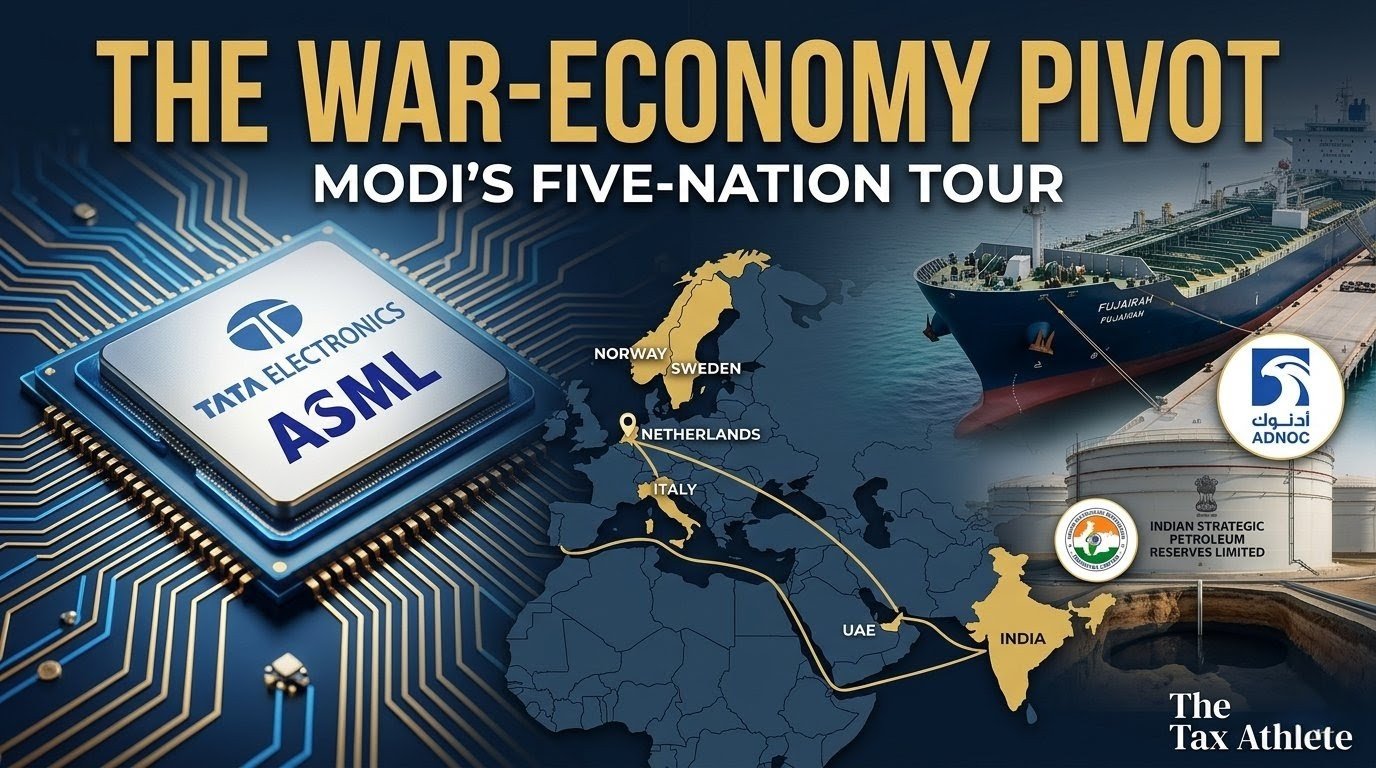
Between 15 May and 20 May 2026, Prime Minister Narendra Modi completed a five-nation tour covering the United Arab Emirates, the Netherlands, Sweden, Norway, and Italy. This was not a ceremonial trip. It was a coordinated economic operation. The agreements signed across these five countries are designed to do one thing for Indian businesses: remove the external vulnerabilities that drain your margins, disrupt your supply chains, and complicate your compliance picture.
In our previous session on the War-Economy Playbook, we analyzed how geopolitical friction across West Asia acts like a sudden hamstring tear for global trade. Freight insurance spikes. Shipping routes detour. Electronic components vanish from shelves. Energy bills stop behaving predictably.
An elite athlete does not walk off the track when the weather changes. You adapt your strategy, strengthen your core, and protect your stamina for the long race ahead. That is precisely what this diplomatic circuit was designed to do for India Inc.
Let us break down each leg of the tour, verify what was actually signed, and translate the outcomes into plain business language.
Section 1: The UAE Stop — Building a Fuel Buffer Inside Indian Borders
Why Energy Security is the Cardiovascular System of Business
India imports more than 85 percent of its crude oil requirements from foreign suppliers. A very large portion of that oil travels through the Strait of Hormuz, a narrow stretch of water between Iran and Oman that serves as the primary exit point for Persian Gulf energy.
When tensions flare in West Asia, as they have been doing throughout 2025 and 2026, that bottleneck becomes a pressure point. Spot prices for crude spike immediately. Maritime insurance premiums follow. Refineries and manufacturers that depend on a steady flow of affordable feedstock start feeling the squeeze within days. Your fuel bills go up. Your logistics costs go up. And the regulatory environment around energy compliance becomes unpredictable.
What Was Actually Agreed in Abu Dhabi
On 15 May 2026, Prime Minister Modi met UAE President Sheikh Mohamed bin Zayed Al Nahyan in Abu Dhabi. The UAE committed investments totalling five billion US dollars directed toward Indian infrastructure, financial institutions, and housing finance. Alongside this capital commitment, the Abu Dhabi National Oil Company received approval to expand its crude oil storage capacity inside India to thirty million barrels.
Investment Commitment: USD 5 billion from UAE entities into Indian infrastructure and financial institutions.
ADNOC Storage Expansion: Up to 30 million barrels of crude stored inside India at Strategic Petroleum Reserve facilities.
LPG Supply: Indian Oil Corporation secured long-term supply arrangements for liquefied petroleum gas.
Reciprocal Framework: Indian Strategic Petroleum Reserves Limited gains access to store crude at Fujairah, located on the Gulf of Oman, clear of the Persian Gulf.
What This Means for Your Business
Thirty million barrels sitting inside Indian underground rock caverns at Visakhapatnam, Mangaluru, and Padur means your fuel supply chain has a buffer that does not depend on anything floating through a contested maritime channel. If a crisis closes Hormuz tomorrow, those reserves get routed directly to Indian refineries. Your fuel costs do not spike the same week a conflict escalates overseas.
For manufacturers, logistics companies, and any business with significant energy costs, this arrangement converts a volatile, floating supply chain into a concrete domestic asset. Long-term price stability becomes a realistic planning assumption rather than an optimistic hope.
Section 2: The Netherlands Stop — Building India’s Chip Factory
Why Microchips Are the Central Nervous System of Modern Industry
Every industry you can name runs on semiconductors. Automotive manufacturing, medical devices, industrial automation, mobile communications, enterprise software, electric vehicles, defence systems. The global chip shortage of 2021 was a sharp lesson in what happens when your supply of these components gets disrupted. Factories shut down. Production lines stopped. Revenue targets were missed by billions of dollars.
India currently imports the bulk of its microchips. It does not manufacture advanced semiconductors at the commercial scale that domestic industry requires. That dependency is a genuine strategic vulnerability, particularly as geopolitical tensions between major semiconductor-producing nations drive export restrictions and supply realignments.
The ASML Deal: What It Is and Why It Matters
On 16 May 2026, in The Hague, Tata Electronics and ASML signed a Memorandum of Understanding, witnessed by Prime Minister Modi and his Dutch counterpart Rob Jetten. This was the flagship agreement of the Netherlands leg.
To understand why this deal matters, you need to understand what ASML does. ASML, headquartered in Veldhoven in the Netherlands, manufactures the lithography machines used to print microscopic circuit designs onto silicon wafers. There is no other company in the world that makes the most advanced versions of these machines. ASML effectively holds a dominant global position in the production of photolithography equipment. Without these machines, modern semiconductor chips physically cannot be manufactured.
Location: Dholera Special Investment Region, Gujarat.
Investment: USD 11 billion by Tata Electronics.
Wafer size: 300mm (12-inch), India’s first commercial front-end fab at this scale.
Process nodes: 28nm to 110nm, using ASML’s Deep Ultraviolet (DUV) lithography tools.
Target sectors: Automotive systems, mobile devices, AI applications, industrial automation.
Production timeline: Initial commercial production targeted by late 2026.
Direct employment: Approximately 20,000 jobs at the facility itself.
The MoU commits ASML to supply its lithography tools and engineering solutions to the Dholera facility, support the production ramp-up, develop local talent, and build research infrastructure for India’s long-term semiconductor ecosystem.
A Note on Realistic Expectations
This agreement is genuinely significant, but it helps to understand the full picture. The Dholera fab will manufacture chips at 28nm to 110nm process nodes. These are mature technology nodes, not the cutting-edge sub-7nm chips used in the latest smartphones or AI processors. Those advanced chips will continue to be sourced from TSMC and Samsung for now.
However, a very large portion of real-world industrial demand sits precisely at these mature nodes: automotive microcontrollers, industrial sensors, power management chips, display drivers. For Indian manufacturers in these sectors, a domestic supply of these components eliminates import delays, customs clearance friction, and foreign currency exposure on every component purchase.
India is not sprinting past the world in chip technology. It is building the foundation that allows it to run its own race.
Section 3: The Nordic Stops — Sweden and Norway
Sweden: The Innovation Partnership 2.0
Between 17 and 18 May 2026, Prime Minister Modi visited Stockholm, where India and Sweden elevated their bilateral relationship to a formal Strategic Partnership. The two countries adopted a Joint Action Plan covering 2026 to 2030, with a core target of doubling bilateral trade and investment within five years.
The standout initiative is the India-Sweden Joint Innovation Partnership 2.0, a framework establishing a virtual joint science and technology centre focused on artificial intelligence, 6G communication networks, quantum computing, and smart grid technologies. For technology enterprises and startups, the accompanying India-Sweden SME and Startup Platform creates structured access to Scandinavian capital and advanced industrial networks.
Norway: The Green Strategic Partnership
The Oslo stop on 19 May 2026 was historically significant. It was the first visit by an Indian Prime Minister to Norway in 43 years. Prime Minister Modi participated in the third India-Nordic Summit, which also included leaders from Denmark, Finland, and Iceland, focusing on green technology, artificial intelligence, and climate cooperation.
The bilateral outcome was the elevation of India-Norway ties to a Green Strategic Partnership. Norway brings deep industrial expertise in maritime engineering, hydrogen fuel cells, clean energy storage, and the maritime blue economy. For Indian shipping and logistics companies, this partnership creates structured access to next-generation, energy-efficient maritime technologies that are directly relevant to tightening international carbon compliance frameworks.
| Country | Partnership Level | Core Focus | Business Relevance |
|---|---|---|---|
| Sweden | Strategic Partnership | AI, 6G, Quantum, Smart Grids | Deep-tech R&D access, startup capital channels, bilateral trade expansion |
| Norway | Green Strategic Partnership | Hydrogen, Maritime Blue Economy, Clean Energy Storage | Maritime decarbonisation technology, carbon compliance readiness for shipping |
Section 4: The Italy Stop — The Mediterranean Trade Highway
The tour concluded in Rome on 20 May 2026. Prime Minister Modi and Italian Prime Minister Giorgia Meloni elevated bilateral ties to a Special Strategic Partnership, the highest diplomatic classification available. The two leaders set a bilateral trade target of 20 billion euros by 2029.
Italy’s strategic relevance here extends beyond the bilateral numbers. Italy anchors the western end of the India-Middle East-Europe Economic Corridor, a structured trade highway designed to reduce Indian exporters’ and importers’ dependence on volatile maritime channels in the Gulf region. With the India-EU Free Trade Agreement negotiations also concluded earlier in 2026, the Italy stop lands at a commercially powerful moment.
Defence Industrial Roadmap
The India-Italy Defence Industrial Roadmap creates a structured framework for joint defence manufacturing and technology transfers inside India. This is directly aligned with the national push for defence indigenisation. For domestic engineering firms, precision component manufacturers, and fabricators, this opens structured entry points into the defence supply chain.
Critical Minerals Agreement
The critical minerals cooperation pact signed in Rome is quietly one of the most commercially important outcomes of the entire tour. The global shift toward electric vehicles, high-performance battery storage, advanced electronics, and AI hardware is creating enormous demand for materials like lithium, cobalt, nickel, and rare earth elements. These materials are currently concentrated in a small number of countries, many of which operate within competing economic blocs that could impose export restrictions at short notice.
The critical minerals agreement with Italy provides Indian electronics and automotive manufacturers with a structured channel for sourcing and processing these materials, reducing exposure to the kind of sudden supply disruptions that have hit other industries when geopolitical tensions shift commodity access.
Section 5: The Business Playbook
Large diplomatic agreements filter down into daily balance sheets over time. Here is how the five-nation outcomes translate into concrete business actions.
With thirty million barrels of crude stored domestically and long-term LPG supply arrangements secured, energy price stability is a more realistic planning assumption than it was twelve months ago. Revisit your cost-per-unit models to reflect a more stable baseline energy input. Businesses that locked in fuel surcharges or passed volatile energy costs onto customers may need to revisit those pricing structures.
Once the Dholera facility enters commercial production, mature-node chips for automotive, industrial, and consumer electronics applications will be available domestically. For GST purposes, domestic sourcing simplifies your input tax credit chain by removing the customs duty layer on imported components. Working capital tied up in upfront customs payments gets released. Map your current component imports against the 28nm to 110nm node categories to identify what becomes sourceable domestically within the next two to three years.
The government’s Production Linked Incentive schemes reward incremental manufacturing expansion in electronics, semiconductors, and related sectors. Capital expenditure on system design, prototyping, and advanced software integration qualifies for R&D deductions under domestic tax frameworks. If your business is expanding into the electronics or defence supply chain, the tax planning opportunity here is substantial. A qualified tax advisor should be reviewing your capital expenditure structure against available incentives now, not after the projects are sanctioned.
The Norway Green Strategic Partnership accelerates access to maritime decarbonisation technology. International carbon compliance frameworks are tightening, and shipping companies operating on international routes are already facing reporting obligations under EU and IMO frameworks. If your business involves international freight, the hydrogen and clean energy maritime partnerships emerging from this agreement are directly relevant to your medium-term compliance costs. Start modelling the transition before the regulations arrive, not after.
If your business is in electric vehicles, battery manufacturing, advanced electronics, or defence components, the critical minerals agreement with Italy and the broader diplomatic architecture being built across these five countries provides structural protection against the kind of sudden raw material shortages that disrupted manufacturers globally during the pandemic years. Use this window to diversify supplier relationships and negotiate medium-term supply contracts while pricing and access remain relatively stable.
Conclusion: The Long Race Requires a Strong Core
The 2026 five-nation tour demonstrates something important about how economic policy works at the highest level: energy security, semiconductor access, critical mineral supply, and trade connectivity are no longer separate policy tracks. They are one integrated architecture, and this diplomatic circuit was designed to reinforce every pillar of it simultaneously.
For Indian businesses, the window between the signing of these agreements and the date they become operational realities is the most valuable period available. The companies that audit their supply chains now, align their capital expenditure with the incentive structures being built, and position themselves inside the new trade corridors will carry significantly lower risk and higher margins into the second half of this decade.
An elite athlete does not wait for the race to start before conditioning their body. The track is being built. Your preparation starts today.
Tata Electronics and ASML: Joint press release and Memorandum of Understanding signed in The Hague on 16 May 2026.
Indian Strategic Petroleum Reserves Limited: Operational data on underground crude storage facilities at Visakhapatnam, Mangaluru, and Padur.
Indian Oil Corporation: Long-term LPG supply arrangements confirmed via official press release, May 2026.
Ministry of External Affairs: Joint statements from the India-Nordic Summit, Oslo, 19 May 2026, and the India-Italy Special Strategic Partnership declaration, Rome, 20 May 2026.