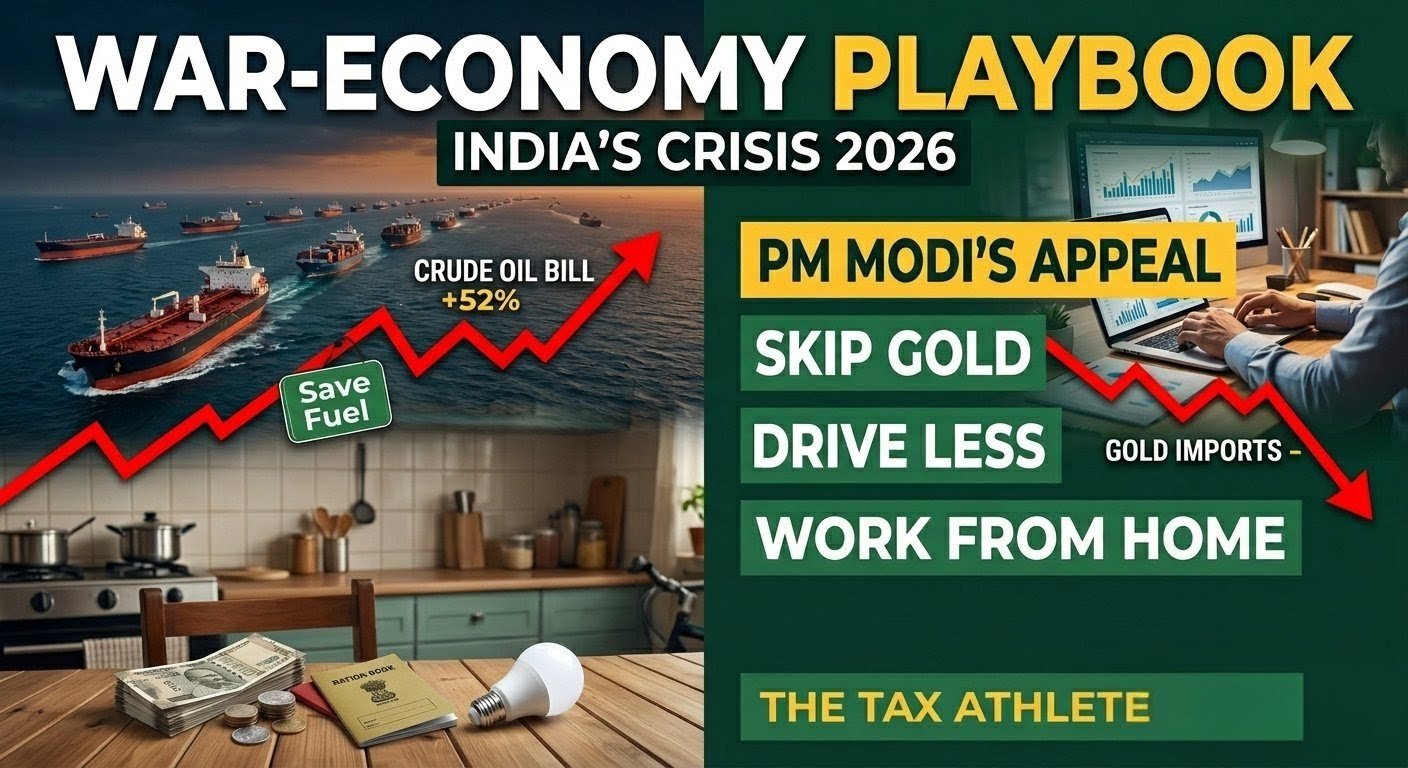
On 11 May 2026, Prime Minister Narendra Modi stood before a crowd in Vadodara and said something that would have sounded completely out of place a year ago. He did not talk about a new virus. He did not announce an election. He asked ordinary Indian families to stop buying gold for a year, drive less, cancel their foreign holidays and where possible, work from home.
That single speech activated what economists and policymakers are now openly calling India’s war-economy playbook.
This is not a figure of speech. The conflict between the United States and Iran has effectively shut down the Strait of Hormuz, the narrow waterway through which nearly half of India’s crude oil and natural gas imports travel. Oil prices surged from roughly $70 per barrel before the conflict to a peak of $126 per barrel, with the sustained trading range sitting between $100 and $115 through May 2026. India imported 4.3 percent less crude oil by volume in April 2026 compared to April 2025. Yet the import bill for that oil jumped by over 52 percent, rising from $10.7 billion to $16.3 billion in a single month.
When a country imports 85 to 90 percent of its crude oil and more than 90 percent of its gold using American dollars, a war in the Gulf is not a foreign problem. It arrives at the kitchen table.
This post will break down exactly what the war-economy playbook means, why the government is asking you to make personal sacrifices on behalf of the national balance sheet, how Indian businesses are already being forced to adapt and what opportunities are emerging from this disruption.
| Metric | April 2025 | April 2026 | Change |
|---|---|---|---|
| Crude Oil Import Volume | 21.0 MMT | 20.1 MMT | -4.3% |
| Crude Oil Import Bill | $10.7 Billion | $16.3 Billion | +52.3% |
| LNG Import Bill | $1.2 Billion | $0.9 Billion | -25.0% |
The table tells a story that no speech can soften. India is paying significantly more money for meaningfully less fuel. The pressure on the national current account, foreign exchange reserves and the rupee is real and is building by the week.
This Is Not the First Time India Has Played This Game
Before unpacking the mechanics of the current crisis, it is worth taking one step back in history. The 2026 playbook feels new, but the moves inside it are not.
The 2013 Current Account Deficit Crisis
Thirteen years ago, India faced a different kind of external pressure, but it reached for the same tools. The United States Federal Reserve in 2013 signalled that it would begin winding down its post-2008 economic stimulus program, triggering what markets now call the “Taper Tantrum.” Capital fled from emerging markets. The Indian rupee fell by nearly 20 percent between January and September of that year.
At the same time, global gold prices dipped, which set off a buying frenzy in Indian households. Gold imports surged to over 150 tonnes per month against a normal monthly average of 70 tonnes. Because every gram of gold is purchased with foreign currency, this surge pushed India’s Current Account Deficit, which measures how much more a country spends abroad than it earns, to a peak of 4.8 percent of GDP in 2012-13.
Then Finance Minister P. Chidambaram responded with a combination of public appeals and hard policy. Specifically, he called on Indian households to stop buying gold for six months to a year, arguing that the country’s economic landscape would change dramatically if citizens simply stopped demanding the metal. In addition, the government raised customs duty on gold from 6 percent to 10 percent across three separate hikes through 2013.
Furthermore, the Reserve Bank of India introduced the 80:20 rule, which required that 20 percent of all imported gold be re-exported as jewellery before any new import shipment could be cleared. Banks were also barred from selling gold coins altogether.
The measures worked. Gold imports fell sharply, the current account deficit narrowed and the rupee stabilised.
What Makes 2026 Different and Harder
In 2013, oil prices were stable. Therefore, the government was fighting one battle: stopping a gold obsession from draining foreign currency. Today, however, the administration is fighting two battles at once. Crude oil prices have more than doubled from their pre-crisis levels and gold imports were already running at a record high of $71.98 billion in FY 2025-26 before the conflict escalated further.
India’s overall trade deficit reached $333.2 billion in 2025-26 and the April 2026 monthly trade deficit widened to $28.38 billion, well above analyst forecasts. The rupee has fallen to record lows against the dollar. Foreign investors pulled more than $20 billion out of Indian equity markets in just the first four months of 2026. GDP growth forecasts for the fiscal year ending March 2027 have been slashed from 7.7 percent to 6.7 percent by analysts at Fitch’s BMI unit.
The core problem is the same as 2013. The tools are similar. But the scale of the damage is considerably larger this time around.
Why the Government Is Asking You to Skip Gold Purchases
Gold carries enormous cultural weight in India. It is the default asset for weddings, festivals, savings and inheritance. The problem is that India produces almost none of its own gold. Every gram that enters the country must be purchased on international markets using US dollars.
In FY 2025-26, India’s gold import bill hit an all-time high of $71.98 billion, a 24 percent jump from $58 billion the previous year. The volume of gold imported actually fell from 757 tonnes to 721 tonnes, which means price was the sole driver. Gold prices at the import stage jumped from roughly $76,617 per kilogram in FY25 to $99,825 per kilogram in FY26. The West Asia crisis then pushed global gold prices even higher because gold is universally treated as a safe-haven asset during wartime — when the world feels dangerous, investors and households everywhere reach for gold simultaneously, driving prices up further.
By asking Indian families to defer non-essential gold purchases for one year, the government is attempting to stop a massive outflow of American dollars at exactly the moment those dollars are needed to pay a war-inflated energy import bill. Every rupee worth of gold demand that a family decides to postpone is a dollar that stays inside India’s foreign exchange reserves.
The government has also matched Modi’s public appeal with formal policy. The Central Board of Indirect Taxes and Customs has raised the Basic Customs Duty on gold from 5 percent to 10 percent and the Agriculture Infrastructure and Development Cess from 1 percent to 5 percent. The policy mechanics are almost identical to 2013. The urgency, however, is considerably higher.
Why the Government Is Asking You to Drive Less
The crude oil situation is even more critical than the gold problem. The Strait of Hormuz is a waterway barely 33 kilometres wide at its narrowest navigable point, nestled between Oman and Iran. Through it flows roughly 20 percent of global oil supply and nearly half of India’s crude oil and LNG imports.
The 2026 Iran-US conflict has effectively closed that corridor. Over 40 percent of India’s crude oil flows that passed through the Hormuz have been cut off. India’s oil marketing companies, the firms that refine and retail fuel, are absorbing losses of up to Rs 1,000 crore per day because the government has kept retail petrol and diesel prices artificially stable to prevent a cost-of-living shock for ordinary citizens. This is, as Oil Minister Hardeep Singh Puri acknowledged publicly, unsustainable if the conflict drags on.
Behind the scenes, the government has already limited commercial establishments to 70 percent of their historical LPG consumption to preserve reserves. Ships carrying crude from alternative sources must now travel around Africa’s Cape of Good Hope instead of through the Red Sea and Suez Canal, adding 10 to 20 transit days and pushing ocean freight costs up by 40 to 50 percent.
The work-from-home appeal is essentially a demand-suppression strategy. If millions of white-collar workers stay home two or three days a week instead of commuting, the cumulative reduction in petrol and diesel consumption across the country creates a genuine macroeconomic buffer. Every litre saved is a litre India does not have to import at wartime rates.
The Direct Connection to Inflation
How Oil Prices Reach Your Grocery Bill
The reason this matters beyond balance sheets and reserve numbers is inflation. Crude oil is a foundational input for the entire Indian economy. Diesel powers the trucks that carry vegetables from farms to cities. Electricity generated by fuel runs the generators in factories. On top of that, crude is the raw material for plastics, fertilisers, synthetic textiles and hundreds of industrial chemicals.
When the import price of crude rises by 52 percent, that cost eventually flows through to every retail shelf in the country. Economists call this imported inflation. In simple terms, a war in the Gulf eventually arrives as higher prices at a Mumbai grocery store or a Chennai restaurant — because almost everything that reaches those shelves was either made using fuel or transported using it.
As covered in the Inflation Sprint post from earlier this year, the Finance Bill 2026 amendments around safe harbour margins, ITC optimisation and Section 15 were already being shaped in anticipation of exactly this kind of cost-push pressure on Indian businesses. In many ways, the war-economy playbook is the government’s attempt to break that inflationary transmission cycle before it reaches full force. Moreover, if national fuel demand can be suppressed, wholesale energy costs for industry rise less than they otherwise would — and the ripple effect into consumer prices is meaningfully dampened.
What This Means for Indian Businesses
The corporate impact is already visible and moving fast.
The Return of Work From Home, but for Different Reasons
During the pandemic, work from home was a public health measure. In May 2026, it is a macroeconomic one. The motivation is completely different, but for many businesses the operational challenge is the same: how do you maintain productivity with a partially remote workforce?
HDFC Bank, India’s largest private sector lender with a workforce of nearly two lakh employees, has introduced a two-day-per-week work-from-home arrangement for staff in Business Enabling and Corporate Enabling Functions. This covers departments such as IT, treasury operations, credit underwriting, risk management, HR, finance, legal and compliance, with an initial trial period of 30 days.
Other institutions have followed. IndusInd Bank has introduced a hybrid work policy for select employees. Axis Bank has continued its existing hybrid model for non-customer-facing roles. Even the Supreme Court of India has shifted its miscellaneous day hearings entirely to video conferencing and introduced rotational remote work for its registry offices.
For service-sector companies, software firms and financial institutions that can operate effectively on screens, the transition is manageable. However, the challenge becomes considerably more complex when you look at who cannot simply work from home.
The Harder Road for Manufacturers and MSMEs
Manufacturing units, construction firms, logistics companies and the millions of small and medium enterprises that depend on physical supply chains are not able to simply pick up their laptops and stay home. These are the businesses that are absorbing the full impact of the crisis on multiple fronts simultaneously.
Petrochemical raw materials such as plastic granules and synthetic resins are in short supply as the disruption spreads through the Gulf supply chain. As a result, the manufacturing PMI, a measure of factory activity, has already recorded sharp declines this year. Smaller businesses that lack capital reserves to absorb prolonged cost shocks are under the most severe pressure. For example, an MSME textile manufacturer in Surat buying imported synthetic yarn, shipping goods by road and running equipment on diesel is facing a cost increase at almost every point in its production cycle at once.
For larger import-export businesses, the Cape of Good Hope rerouting adds direct freight cost increases of 40 to 50 percent. Marine insurance premiums have also risen by up to 20 percent as underwriters price in the elevated risk of operating vessels anywhere near the Gulf region. These are not abstractions. They hit the landed cost of imported raw materials and the competitive price of Indian exports on the global market.
The Silver Lining: What This Crisis Is Accelerating
History consistently shows that severe external shocks, when they do not break an economy, tend to accelerate structural transitions that were already overdue. India in 2026 is leveraging this disruption to fast-track three transitions that have been in slow motion for years.
Electric Vehicles Move From Aspiration to Imperative
Importing fossil fuels at wartime prices has transformed the economics of the EV transition overnight. What was previously an environmental goal and a long-term industrial policy has, as a result, become a national security imperative. Consumer interest in electric two-wheelers and passenger cars has surged sharply.
In response, the government is directing public sector undertakings to replace their diesel and petrol vehicle fleets with electric alternatives. Additionally, the Production Linked Incentive schemes, announced in the Union Budget 2021-22 with a total outlay of Rs 1.97 lakh crore across 14 sectors as confirmed by the Ministry of Finance, are being accelerated toward domestic gigafactories and battery pack assembly lines. Consequently, the crisis has done in weeks what years of policy persuasion could not: it has made the cost argument for EVs undeniable for millions of Indian consumers and businesses.
Electronics and Defence Manufacturing Move Inward
Semiconductors are the tiny chips that power every smartphone, laptop, television and modern vehicle. To make them, factories need specialised chemical materials and adhesives that were previously imported from Gulf-region suppliers. Those supply chains are now disrupted. Indian electronics manufacturers are being forced to source these materials locally for the first time, building domestic supply chains they had no financial reason to develop before this crisis. The defence sector is seeing the same push under the Make in India initiative, with domestic firms scaling up production of communication equipment, unmanned aerial vehicles and advanced defence components as global military supply chains tighten.
Agriculture Moves Away From Imported Chemicals
Chemical fertilisers sit at the centre of India’s agricultural import problem. India imports 78 percent of the natural gas used to produce urea, 100 percent of its potash and 80 to 90 percent of its phosphate — nearly all of it from countries in or near the Gulf region. The fertiliser subsidy bill for 2026-27 was initially budgeted at $18.38 billion. With Gulf supply chains now disrupted and global gas prices elevated, that bill is expected to overshoot by nearly 10 percent, potentially reaching $21.5 billion according to FAO India estimates.
PM Modi has explicitly asked farmers to cut their use of chemical fertilisers by 50 percent and shift toward natural farming practices. If this takes root even partially, it would reduce the import bill, protect soil health and lower a subsidy burden that the government has struggled to contain for years. India’s fertiliser import dependence is one of the least-discussed vulnerabilities in the national economy. The West Asia crisis has brought it into sharp focus for the first time.
What Can You Actually Do Right Now?
A war-economy strategy only works if citizens cooperate with it. Here is a practical breakdown of how individual and business-level choices connect to the national outcome.
- Defer physical gold purchases for one year. If you need the financial safety net that gold provides, consider sovereign gold bonds or gold ETFs instead. These instruments provide exposure to gold price movements without requiring the import of physical metal, so they do not drain foreign exchange reserves in the same way.
- Maximise virtual meetings and work-from-home days. If your role can be performed remotely, coordinate with your employer to formalise a hybrid arrangement. Every day of commuting avoided reduces personal fuel expenditure and contributes to the collective national demand-reduction effort.
- Rethink international travel plans for 2026. Foreign tourism, destination weddings abroad and international conferences involve both foreign exchange outflows and fuel consumption. Deferring or replacing these with domestic alternatives keeps spending circulating inside the Indian economy.
- Support domestically manufactured goods. Choosing Indian-made alternatives over imported consumer products directly reduces the trade deficit and keeps rupees within the domestic economy.
- Review your business ITC strategy under the current cost environment. Rising input costs from disrupted supply chains make it more important than ever to optimise input tax credit claims on freight, logistics and raw material procurement. The Finance Bill 2026 ITC post covers the current framework in detail.
The Road Ahead
India has nearly one crore citizens living and working across the Gulf region. Therefore, the stakes in West Asia are not just financial for this country. They are personal, emotional and deeply human.
What is now being called the war-economy playbook is, at its core, a recognition that India cannot simply wait for the conflict to end and for oil prices to normalise. As a result, the country must actively reshape its consumption patterns, accelerate structural transitions and deploy every available tool to protect the currency, manage the import bill and keep inflation from spiralling into a domestic crisis.
The 2013 Lesson: India Has Done This Before
The 2013 episode showed that India can do this. The interventions worked then. Nevertheless, the current challenge is larger and more complex, running across two simultaneous fronts. The underlying logic, however, remains the same: national financial discipline applied collectively at the household and business level translates directly into macroeconomic resilience.
A Training Block, Not Just Austerity
This is not austerity for its own sake. Instead, think of it as a training block — a period of deliberate discipline with a specific performance goal on the other side. The aim is to emerge from this period structurally stronger, less dependent on a single chokepoint for energy, less reliant on imported raw materials for manufacturing and more self-sufficient across the sectors that matter most for long-term growth.
Ultimately, the test of the war-economy playbook is not just whether the government can hold the rupee together for the next few months. It is whether India uses the pressure of this moment to build something more durable on the other side of it.
Frequently Asked Questions
Why is PM Modi asking Indians to stop buying gold in 2026?
India does not produce its own gold and must import nearly all of it using US dollars. In FY 2025-26, India’s gold import bill hit a record $71.98 billion, contributing to a trade deficit of $333.2 billion. With the West Asia crisis simultaneously pushing the crude oil import bill up by over 52 percent, every dollar saved on gold imports directly strengthens India’s foreign exchange reserves and helps stabilise the rupee.
How does the Strait of Hormuz closure affect Indian businesses?
The Strait of Hormuz is a narrow waterway through which roughly half of India’s crude oil and LNG imports travel. The 2026 Iran-US conflict has effectively cut off over 40 percent of India’s crude oil flows through this route, driving up the import bill by over 52 percent in April 2026 alone. Ships rerouting around Africa’s Cape of Good Hope add 10 to 20 days of transit time and push ocean freight costs up by 40 to 50 percent, directly squeezing Indian manufacturers and small businesses.
Has India done this before?
Yes. In 2013, during a severe Current Account Deficit crisis, Finance Minister P. Chidambaram publicly appealed to Indian households to stop buying gold for six months to a year. The government also raised customs duty on gold from 6 percent to 10 percent and introduced the 80:20 import rule, which required exporters to re-export 20 percent of imported gold before new shipments could be cleared. The current 2026 playbook is strikingly similar, but the scale of the problem is significantly larger.
What is the war-economy playbook and what does it mean for the average Indian?
The war-economy playbook is a set of demand-suppression measures the government uses during periods of severe external economic stress. For the average Indian in 2026, this means PM Modi’s appeals to defer gold purchases for one year, reduce personal fuel consumption, avoid foreign vacations and work from home wherever possible. These steps collectively aim to reduce the outflow of US dollars at a time when the import bill is under extreme pressure from the West Asia crisis.
1. The Week — PM Modi repeats appeals amid West Asia crisis, 11 May 2026
2. CNBC — Modi says Iran war poses severe risks to India, 11 May 2026
3. DD News on Air (PIB) — PM Modi’s seven appeals for economic self-reliance
4. IndexBox — India Trade Deficit April 2026: Widens to $28.38 Billion
5. OilPrice.com — India’s Oil Crisis Deepens as Hormuz Remains Shut, 14 May 2026
6. Discovery Alert / Kpler Analysis — India’s Crude Oil Stocks Drop Amid Iran Conflict in 2026
7. Millennium Post — India’s gold imports rise 24% to $71.98 billion in 2025-26
8. Bizz Buzz — India’s gold imports surge to record $71.98 billion in FY26
9. Business Today — Why Jefferies sees FY13 gold crisis echoes in PM Modi’s latest appeal, 12 May 2026
10. Outlook Business — Will PM Modi’s Appeal and Duty Hike Trigger a Gold Rush or Gold Pause?
11. Discovery Alert — India’s Gold Buying Freeze: What It Signals for Global Markets, 2026
12. Reuters / Business Standard — India hopes to contain gold imports below last year’s level, July 2013
13. Business Standard — CAD to be less than $40 billion: Chidambaram, 2014
14. Business Today — PM Modi’s WFH push gains pace: HDFC, IndusInd roll out remote work, 20 May 2026
15. India Briefing — Strait of Hormuz and India’s Oil Supply: Import Dependencies and Mitigation Measures