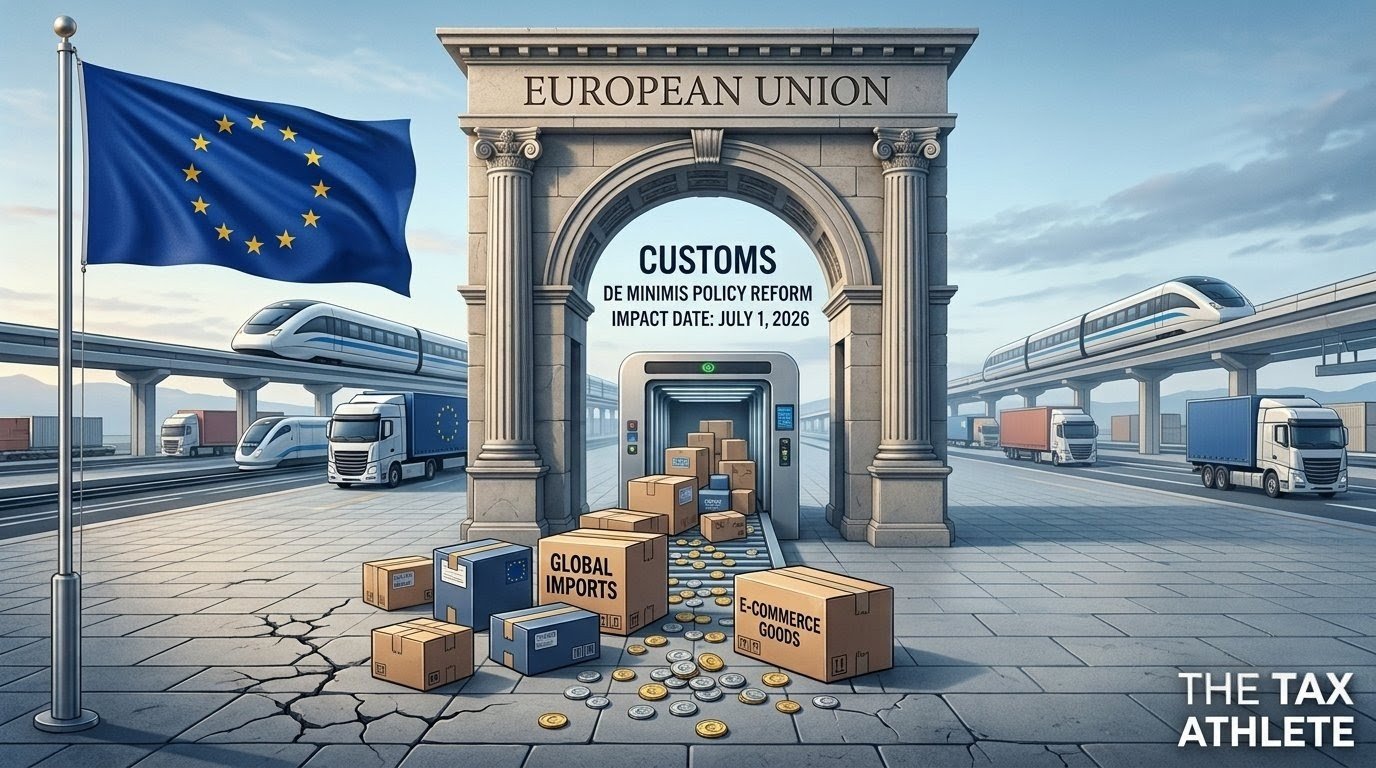
EU Customs Reform • Effective July 1, 2026
The Death of De Minimis:
What Indian E-Commerce Sellers Must Do Before July 1, 2026
The European Union has just retired its most famous duty-free loophole. Here is what the new flat €3 customs duty really costs you, and the one strategic pivot that keeps your European margins alive.
Imagine a fast-track lane at a race circuit that lets overseas teams skip the standard technical weigh-in. For over a decade, non-EU e-commerce brands have been running through exactly that lane. Every small parcel — a phone case, a piece of fashion jewellery, a Bluetooth speaker — could cross the border of any European Union member state completely free of customs duties, provided its value stayed under €150. That lane is now permanently closed.
On July 1, 2026, the European Union officially abolished the de minimis rule — the duty-free exemption on low-value consignments — under Council Regulation (EU) 2026/382. In its place, a flat €3 customs duty per item category now applies to every qualifying parcel entering the EU from a non-EU country. A proposed €2 Union handling fee per parcel is expected to stack on top from November 2026. If you are an Indian seller, a UK-based brand, or any non-EU business currently shipping individual orders directly to European customers, this post is your emergency briefing.
First, What Was the De Minimis Rule?
The de minimis rule (a Latin phrase meaning “about minimal things”) was a customs exemption built into EU law that allowed commercial parcels with an intrinsic value — the price of the goods alone, excluding separately listed shipping and insurance costs — of €150 or less to enter any of the 27 EU member states completely free of import customs duties.
It was created to protect customs authorities from being buried under paperwork for tiny, low-value shipments. Instead of an officer manually processing a duty of, say, €0.80 on a €5 keychain, the rule simply said: parcels under €150, no duty, move on. This was a practical administrative shortcut designed for a world where cross-border parcel volumes were manageable.
That world no longer exists. In 2024 alone, approximately 4.6 billion low-value consignments entered the EU — roughly 12 million parcels every single day. The European Commission estimates that figure climbed to nearly 5.9 billion items in 2025. Over 91% of these parcels originated from China, driven largely by ultra-low-cost e-commerce platforms. The duty-free fast lane had become a motorway, and the EU decided to shut it down.
The New Rule: How the €3 Flat Duty Actually Works
The replacement framework under Council Regulation (EU) 2026/382, which received final Council approval on February 11, 2026 and entered into force on March 10, 2026, is deceptively simple on the surface. Look carefully at the mechanics, however, and the financial impact compounds quickly.
From July 1, 2026, every commercial parcel valued at €150 or less, sent directly from a non-EU country to an EU consumer (a B2C, or business-to-consumer, distance sale), must pay a flat €3 customs duty per item category. The “item category” is defined by the parcel’s HS tariff sub-heading — a six-digit code from the Harmonised System (HS), which is the globally standardised product classification language used by customs authorities in over 200 countries. Think of each HS code as a specific sports position: every product in the world is assigned a position, and two products in the same position share one €3 charge, while two products in different positions each trigger their own separate €3 charge.
The Scenario Test: Single vs. Multi-Category Orders
The official EU guidance from the Council’s own published press release uses a particularly precise example: a parcel containing one silk blouse and two wool blouses attracts €6 in duty because silk and wool blouses fall under different HS tariff sub-headings, even though all three items are blouses. Two identical wool blouses in different colours, however, would share one sub-heading and attract only €3. Product classification is everything.
The Hidden Tax Trap: How the New Duty Inflates Your VAT Bill
Here is the calculation that most sellers completely miss, and it is the one that really destroys low-value margins. The €3 customs duty does not just cost you €3. It increases the VAT taxable base — the total amount on which VAT is calculated — which means you end up paying VAT on the duty itself. This is a tax-on-tax compounding effect built directly into EU law.
Under EU VAT Directive 2006/112/EC, the taxable base for import VAT is not simply the retail price of the product. The law requires that VAT be calculated on the sum of the product’s intrinsic value, plus all international transport and insurance costs, plus all customs duties and fees charged by authorities upon import. Every new fee the EU adds to the import process automatically inflates the VAT calculation.
The Numbers: Before vs. After
Take a practical example: an Indian e-commerce brand selling a consumer electronics accessory to a buyer in France. The French VAT rate is 20%. The item is priced at €15 intrinsic value, and the international shipping cost is €5.
The total landed cost of this item rises from €24 to €30 — a 25% increase in delivery cost on an identical product. Crucially, notice that the VAT bill itself rises from €4 to €5. That extra €1 of VAT exists solely because the customs duty and handling fee inflated the base on which VAT is calculated. You are paying VAT on a customs fee. This is the hidden trap that turns a manageable cost into a margin-destroying one for low-ticket items.
The Data Compliance Trap: Why Sloppy Labels Get Parcels Seized
The €3 duty cannot be calculated without knowing the precise HS tariff sub-heading for each item in the parcel. This forces a completely new data discipline on every non-EU seller. From November 1, 2026, providing accurate Product Identifiers (PIDs) — including a valid Global Trade Item Number (GTIN), a manufacturer’s SKU code, and a precise HS code — becomes mandatory for every item in every low-value declaration.
From July 1 to October 31, 2026, PIDs can be provided voluntarily. After November 1, they are legally required. If your customs declaration uses generic labels — “fashion accessory,” “gift item,” or “clothing” — your parcel will be flagged. The consequences are not a small fine. They are processing delays, cargo holding backlogs at EU entry points, and potential seizure of your goods by border authorities.
For Indian exporters accustomed to informal commercial invoices and approximate product descriptions on postal shipments, this data precision requirement represents a completely new operational standard. Every item in your European product catalogue now needs a verified HS sub-heading before you can legally ship it.
The Three-Phase Customs Reform Timeline
The Strategic Pivot: From Direct-to-Consumer Shipping to EU Fulfilment Hubs
The direct-to-consumer, parcel-by-parcel shipping model from a non-EU warehouse into Europe is now, for most product categories and price points, financially unviable. Sending one thousand separate small parcels from a workshop in Mumbai or a warehouse in Chennai directly to one thousand European doorsteps means one thousand individual duty events, each triggering a minimum €3 charge per product category. The math simply does not work anymore.
Think of it like a cricket team trying to score runs in a T20 match by playing one ball per over from a different venue each time. The logistics overhead destroys any chance of putting up a competitive total. The winning strategy is to consolidate your firepower — play your full innings from one crease.
- Each parcel hit with €3 per item category in flat duty
- Each parcel hit with proposed €2 handling fee from Nov 2026
- VAT taxable base inflated by all stacked fees
- 10 to 20 day delivery times, high refusal risk
- Strict PID data required on every single declaration
- Enters via standard B2B commercial import — flat €3 duty does not apply
- Standard EU tariff percentage assessed on wholesale bulk value — typically 0% to 12% per unit, spread across thousands of items
- Subsequent domestic sales treated as local EU transactions — no import fees
- 48-hour domestic delivery, no border friction
When you import inventory in bulk, the cargo enters the EU through a standard B2B (business-to-business) commercial importation channel, not the simplified H7 e-commerce customs declaration stream. The €3 flat duty applies only to the H7 e-commerce stream — it does not apply to bulk commercial imports. Your consolidated shipment is assessed at standard EU customs tariff rates, which vary between 0% and roughly 12% depending on the product type. When that percentage is divided across hundreds or thousands of units in a single cargo, the per-unit customs cost typically falls to a small fraction of a Euro.
Once your stock lands inside an EU fulfilment centre — whether a third-party logistics (3PL) warehouse or an Amazon FBA (Fulfilment by Amazon) facility inside EU borders — every sale to a local European consumer is processed as a domestic transaction. No import fees, no border friction, no H7 declaration required. The buyer receives their order in 48 hours, not three weeks.
How to Execute the Pivot: Four Non-Negotiable Steps
Audit and Classify Your Entire Product Catalogue
Every item you sell into Europe needs a verified, accurate six-digit HS tariff sub-heading before you ship anything. Do not rely on approximate or generic codes. A misclassified bulk shipment at a European port creates storage fees and supply chain disruptions that can be far more damaging than the duty itself. Work with a qualified customs broker or freight forwarder with EU expertise to verify your HS codes.
Secure Verified Country of Origin Documentation
EU bulk import clearance requires accurate country-of-origin certificates for every product line. If you manufacture in India, you need documentation confirming Indian origin. If you source from multiple countries, you need separate paperwork for each origin. This is not a formality — it directly determines the tariff rate applied to your cargo and your eligibility for any preferential trade agreements between India and the EU under any future frameworks.
Establish a European Fulfilment Partnership
Identify a 3PL provider or marketplace fulfilment platform with warehouse infrastructure inside EU borders. Netherlands, Germany, and Poland are the most established logistics hubs for pan-European distribution, offering strong onward domestic delivery networks across all 27 member states. Confirm that your chosen partner has genuine AEO (Authorised Economic Operator) status — the EU’s trusted-trader certification — which simplifies customs clearance for your inbound bulk shipments.
Recalibrate Your Pricing and Incoterms Strategy
Revisit your European retail pricing to absorb the upfront bulk import duty cost, which replaces your previously zero-duty cost. Review your Incoterms — the internationally standardised terms that define who is legally responsible for import clearance and cost at each stage of shipping. Under a DDP (Delivered Duty Paid) arrangement, you control the full compliance chain. Under a DDU (Delivered Duty Unpaid) arrangement, the buyer faces unexpected charges at the doorstep — a customer experience disaster that will tank your European reviews.
What This Means for the Road to 2028
It is critical to understand that July 1, 2026 is not the finish line. It is the starting gun of a multi-year customs transformation. The transitional period running from July 2026 to July 2028 is exactly that: a two-year window for international businesses to restructure their European logistics before the permanent, fully digital customs regime goes live.
When the EU Customs Data Hub launches in July 2028, the entire e-commerce import process will become automated and real-time. Marketplaces and independent sellers will be legally classified as deemed importers, bearing full legal responsibility for customs data accuracy, duty payment, and product safety compliance. Your checkout system will need to integrate directly with EU customs APIs (Application Programming Interfaces — digital connection points that allow your software to communicate automatically with official customs systems) to submit verified transaction data before your products are even loaded onto a vessel.
From October 2026, the European Commission will conduct monthly monitoring to detect whether sellers are deliberately routing shipments away from the IOSS system to avoid the flat-rate duty. Legislative adjustments can be triggered if such behaviour is detected. The enforcement architecture is already being built in parallel with the transitional duty framework.
Frequently Asked Questions
Part 2: Digital Cardio — EMEA E-Invoicing and the Real-Time Compliance Landscape
Part 3: The Three Pillars of ViDA — EU’s Real-Time VAT Revolution
Part 4: CESOP — How the EU Now Watches Every Cross-Border Payment
Part 5: DAC7 and DAC8 — Marketplace Reporting and What It Means for Indian Sellers
Part 6: The AI Audit Trap — EU Algorithmic Tax Risk Scoring Explained
Part 7: EU ViDA: The End of Call-Off Stock Arrangements by 2029
Part 8: The Death of De Minimis — You Are Here
Verified Sources and Legal References
- Council Regulation (EU) 2026/382 — The formal legislation abolishing the €150 customs duty relief threshold and establishing the transitional €3 flat-rate customs duty framework. Final Council approval: February 11, 2026. Entry into force: March 10, 2026. consilium.europa.eu
- European Commission, DG Taxation and Customs Union — Official guidance document on the €3 temporary customs duty for low-value e-commerce imports, implementing rules published in the Official Journal of the EU: June 8, 2026. taxation-customs.ec.europa.eu
- Council of the European Union — Political agreement on abolishing the de minimis threshold: November 13, 2025. Decision on €3 levy implementation: December 12, 2025. consilium.europa.eu
- European Parliament and Council — Political Agreement on EU Customs Reform — Broader customs union modernisation including the Customs Data Hub and deemed importer framework: March 26, 2026. taxation-customs.ec.europa.eu
- EU VAT Directive 2006/112/EC — Governing the taxable base for import VAT, the IOSS scheme, and the inclusion of customs duties and fees within the VAT calculation base for imported goods. Foundational legislation from which the compounding VAT effect derives.
- Commission Implementing Regulation (EU) 2015/2447, Article 222 — Legal definition of “item” for the purposes of the €3 flat duty: each distinct HS tariff sub-heading represented in a consignment.
The information in this post is for educational and strategic planning purposes only. Customs regulations, tariff classifications, and international trade compliance requirements are subject to ongoing legislative updates and varying enforcement interpretations across EU member states. For legal, financial, or customs classification advice specific to your business, consult a qualified indirect tax professional or certified customs broker. The proposed €2 Union handling fee had not received final EU legislative enactment as of the publication date of this post.