Global Trade & Indirect Tax Series
Malaysia Raises E-Invoice Exemption Threshold to RM3 Million: What Small Businesses Need to Know
Warm-Up. We have spent this year tracking how Southeast Asia and the Gulf are rebuilding their tax systems around real-time digital reporting. In the GCC VAT Agreement 2026 post, we watched the Gulf tighten its VAT rulebook. In UAE E-Invoicing: The 5-Corner Model, we saw the UAE build a clearance system from scratch. In EMEA E-Invoicing 2026 Rollouts, we compared how different countries pace their rollouts. Malaysia is running the same race, and it just changed its own pace mid-stride. On August 30, 2026, the government eased the load on more than a million small businesses. Here is exactly what that means for you.
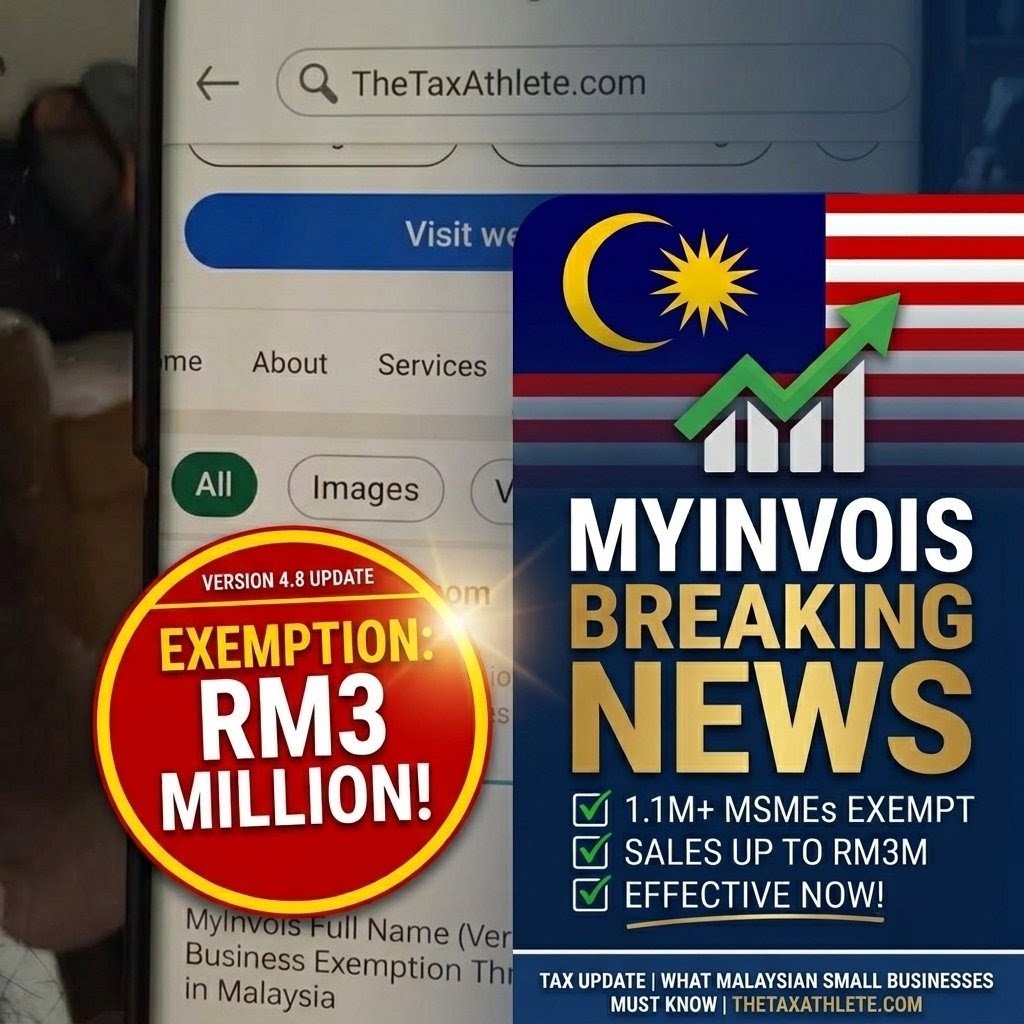
Small business owners in Malaysia received major news about digital tax compliance this week. On August 30, 2026, Prime Minister Datuk Seri Anwar Ibrahim announced a significant policy shift during his National Day address at the Putrajaya International Convention Centre. The Malaysian government has raised the e-invoice exemption threshold for Micro, Small, and Medium Enterprises, known as MSMEs, from RM1 million to RM3 million in annual sales.
The Inland Revenue Board of Malaysia, known as IRBM or LHDN, confirmed the updated e-Invoice Specific Guideline, Version 4.8, dated August 30, 2026. The new threshold takes effect from September 1, 2026, and frees more than 1.1 million small businesses from the mandatory e-invoicing requirement.
This guide breaks down what the change means, who actually qualifies for the exemption, how it affects your daily operations, and why voluntary adoption may still be worth considering even if you are exempt.
It is worth pausing on the setting of the announcement itself. A National Day address is usually reserved for broad national themes, not tax administration detail. The fact that the Prime Minister chose to raise this specific threshold on that stage signals how seriously the government views the pressure that small business owners have been placing on it since the earlier phases rolled out. Business associations across Malaysia had spent months flagging that the original RM1 million line was catching far too many genuinely small operations, including sole proprietors, neighbourhood retailers, and family run shops that had never needed anything more complex than a cash register and a receipt book.
What Is the Malaysia E-Invoicing Mandate?
Malaysia launched its national e-invoicing programme to modernise business transactions, reduce tax evasion, and improve transparency across supply chains. Think of it as swapping a loose training log for a coach who watches every rep in real time.
Under this system, traditional paper receipts and PDF invoices are being replaced by structured digital tax documents. Each transaction is sent directly to LHDN through the MyInvois platform. The platform checks the document, generates a Unique Identifier Number, and adds a verifiable QR code before the document reaches the buyer.
The Main Types of Digital Tax Documents
- Standard invoices. The everyday commercial receipt issued by a seller to record a sale of goods or services.
- Credit notes. Issued by a seller to reduce a transaction value without directly returning funds, for example when goods are returned or a volume discount applies.
- Debit notes. Issued to account for extra costs or price corrections that come up after the original invoice was issued.
- Refund notes. The formal record of money actually returned by a seller to a buyer.
- Self-billed invoices. Invoices generated by the buyer on behalf of the seller, used for specific situations such as commission payments, foreign vendor expenses, or dividend distributions.
Understanding the New RM3 Million Exemption Threshold
The earlier rule required any business with annual sales above RM1 million to fall under the mandatory rollout. Under the newly published Version 4.8 guideline, that line has moved considerably.
| Rule | What It Means |
|---|---|
| Previous standard | Businesses with annual turnover above RM1 million were required to comply. |
| New standard, effective September 1, 2026 | Only businesses with annual revenue exceeding RM3 million must comply. |
| Main impact | More than 1.1 million MSMEs are now exempt from mandatory implementation. |
How the Rollout Phases Work
Malaysia rolled out e-invoicing in stages, starting with the largest taxpayers first, a bit like seeding a tournament from the top-ranked players down to the amateurs. Here is where things stand now that the threshold has moved.
| Phase | Annual Turnover Bracket | Start Date | Status |
|---|---|---|---|
| Phase 1 | Above RM100 million | August 1, 2024 | Fully active |
| Phase 2 | RM25 million to RM100 million | January 1, 2025 | Fully active |
| Phase 3 | RM5 million to RM25 million | July 1, 2025 | Fully active |
| Phase 4 | RM3 million to RM5 million | January 1, 2026 | Active, with the interim relaxation period running until December 31, 2027 |
| Exempt | Up to RM3 million | Not applicable | Exempt under Version 4.8, effective September 1, 2026 |
Note the RM1 million to RM3 million band. Those businesses were technically part of Phase 4 as of January 1, 2026, but the September 1, 2026 exemption now lifts most of them out of the mandate entirely, provided they meet the ownership conditions covered below.
Why Did the Government Raise the Exemption Limit?
Running a small business already means juggling limited resources, tight margins, and daily fires to put out. Adding digital tax software to that mix means spending on point-of-sale upgrades, ERP integrations, staff training, and sometimes professional accounting help.
By raising the threshold to RM3 million, the government is addressing a few pressure points at once.
- Relief from upfront costs. Micro and small enterprises can skip immediate spending on point-of-sale updates and enterprise resource planning integrations.
- Lighter administrative load. Owners can put their energy into sales and daily operations instead of managing a compliance calendar.
- A more gradual transition. LHDN can concentrate its resources on larger enterprises while continuing to build free tools such as the MyInvois Portal, the MyInvois App, and MyInvois e-POS for businesses that choose to join voluntarily.
Important Exceptions: Does Every Small Business Qualify?
The RM3 million threshold offers broad relief, but it is not automatic for every business under that figure. Owners need to look past their own sales number and check their corporate structure too.
The exemption is not based on your standalone turnover alone. According to the published Version 4.8 guideline, a business cannot claim the exemption if it has a non-individual shareholder, a holding company, a related company, or a joint venture partner whose own annual turnover or revenue reaches RM3 million or more. In other words, the ownership test uses the same RM3 million line as the exemption itself, not the older RM1 million figure that applied under the previous guideline.
In practical terms, if your business is majority owned by a larger corporate parent, sits inside a group of related companies, or operates as a joint venture where a partner crosses that RM3 million mark, you are expected to comply regardless of your own standalone sales figure. This is designed to stop larger operations from splitting themselves into smaller entities purely to dodge the mandate.
Consider a simple example. Suppose you run a bakery with annual sales of RM800,000, comfortably under the RM3 million line. On its own, your bakery looks exempt. But if that bakery is a subsidiary of a food and beverage holding company that reports RM4 million in group turnover, the exemption does not apply to you. You inherit the compliance obligation from the parent, regardless of how modest your own till receipts look. The same logic applies to joint ventures. If you co-own a business with a partner whose other operations already cross RM3 million, the joint venture entity is expected to comply as well.
This rule exists for a straightforward reason. Without it, a business sitting comfortably above RM3 million could simply split itself into three or four smaller entities, each reporting sales just under the line, and dodge the mandate entirely. Group and ownership testing closes that loophole.
One point genuinely remains unclear. If a business has already started issuing e-invoices under the old RM1 million threshold and now qualifies for exemption under the new RM3 million line, LHDN has not yet spelled out whether that business can switch e-invoicing off. The guideline states that once an implementation date is set, later changes in a taxpayer’s own turnover do not remove the obligation, but it does not directly address a policy-driven increase in the exemption line itself. If you already went live, it is worth waiting for a dedicated LHDN clarification, or checking with a tax adviser, before switching off your MyInvois process.
Key Rules Every Business Must Remember
Even if your business qualifies for exemption, or sits inside the Phase 4 relaxation period, LHDN keeps a few rules non-negotiable.
1. The RM10,000 Transaction Threshold Rule
Since January 1, 2026, consolidated e-invoices are not allowed for any single transaction above RM10,000. Businesses in a relaxation period are generally allowed to group smaller consumer sales into one monthly consolidated submission. But the moment a single sale crosses RM10,000, a separate, individually validated e-invoice is required for that transaction, no exceptions.
Quick check: Is the single transaction over RM10,000?
If yes, you must issue an individual, validated e-invoice for that sale.
If no, it is eligible to go into your monthly consolidated summary, submitted within seven calendar days after month end.
2. Real Penalties for Non-Compliance
LHDN enforces genuine consequences for businesses that fail to issue proper invoices or file required reports on time. The requirement to issue a valid e-invoice sits under Section 82C of the Income Tax Act 1967, and failure to do so is treated as an offence under Section 120(1)(d) of the same Act. On conviction, this can mean:
- A fine of between RM200 and RM20,000 for each missing or invalid invoice.
- Possible imprisonment of up to 6 months.
- Or both a fine and imprisonment.
Because each non-compliant invoice counts as a separate offence, the exposure grows quickly for a business that mishandles many transactions rather than just one.
3. Grace Periods and Tax Incentives
To soften the transition for businesses that are implementing e-invoicing, LHDN offers a few supportive measures.
- Special Voluntary Disclosure Programme. This allows businesses to correct erroneous or missing e-invoice filings, from July 7, 2026 to December 31, 2027, without facing immediate penalties.
- Tax deduction. Companies can claim a deduction of up to RM50,000 per year of assessment, running from YA2024 through YA2027, for costs incurred in implementing e-invoicing technology.
- Accelerated capital allowance. Qualifying ICT equipment and customised software costs can be claimed over an accelerated 2-year period instead of the standard timeline.
Should You Join Voluntary E-Invoicing Anyway?
As of August 30, 2026, more than 265,000 taxpayers had submitted over 1.84 billion e-invoices since the system went live on August 1, 2024. The government is actively encouraging small businesses below the RM3 million line to adopt the system anyway, even though they are no longer required to.
| Voluntary Adoption | Mandatory Compliance |
|---|---|
| Free access to MyInvois Portal tools | Strict legal enforcement |
| Tax deductions of up to RM50,000 per year | Penalties of up to RM20,000 per invoice |
| Smoother entry into larger corporate supply chains | Required system integration setups |
| A calmer, self-paced rollout | Urgent, deadline-driven software upgrades |
Why Voluntary Adoption Can Still Be a Smart Move
- Supply chain competitiveness. Larger corporate clients already in Phase 1, 2, or 3 often prefer vendors who issue instant e-invoices, since it streamlines their own tax deduction claims.
- Free tools while you wait. LHDN offers no-cost access to the MyInvois Portal, the mobile app, and point-of-sale integrations for businesses that want to get ahead of the curve.
- Future-proofing. If your sales are trending toward RM3 million, your team gets comfortable with digital record-keeping well before it becomes compulsory, the same way an athlete trains before the qualifying round rather than during it.
Step-by-Step Action Plan for Small Businesses
The 5-Step MSME Action Checklist
- Review your past annual sales. Check your official financial statements and tax filings to confirm whether your sales stay below RM3 million.
- Audit your ownership structure. Confirm your business does not have a corporate parent, related company, or joint venture partner with turnover at or above RM3 million.
- Monitor large sales. Train sales and cashier staff to flag any single purchase over RM10,000, since it always needs its own individual e-invoice.
- Check your software. Speak with your point-of-sale or accounting software provider to see whether your current system can produce e-invoice formats if you decide to go voluntary later.
- Register on MyInvois. Sign up on the portal early to explore the free tools, even if you do not plan to use them right away.
Frequently Asked Questions
Do I need to do anything if my business already sits below RM3 million and has no corporate parent?
No immediate action is legally required. You are exempt from the mandatory e-invoicing rules from September 1, 2026 onward. It is still worth registering on the MyInvois Portal so you understand the system before it eventually becomes relevant to you.
What happens if my sales grow past RM3 million next year?
Once your turnover crosses RM3 million, you move into the mandatory bracket for the phase that matches your revenue band. LHDN generally bases this on your most recent audited financial statements or tax return, so it is worth tracking your run rate through the year rather than waiting for year end to find out.
Can I still issue a monthly consolidated invoice if most of my sales are small but one customer pays RM15,000 in a single transaction?
You can still consolidate the smaller sales into your monthly summary. But that single RM15,000 transaction must get its own individually validated e-invoice, since it crosses the RM10,000 threshold. Mixing it into a consolidated batch would not meet the requirement.
Does the exemption apply to freelancers and sole proprietors?
Yes, the same RM3 million annual revenue test applies regardless of business structure, so long as the ownership and group conditions described above do not pull you into the mandatory bracket.
Is the RM3 million threshold permanent?
LHDN has not indicated an expiry date for the new threshold, but tax thresholds in Malaysia have already moved twice in under a year, first from RM500,000 to RM1 million, and now from RM1 million to RM3 million. Business owners should treat this as the current rule rather than a fixed, permanent number, and keep an eye on future LHDN guideline updates.
Strategic Takeaways for Business Growth
The updated RM3 million exemption threshold gives small businesses across Malaysia genuine breathing room. It frees up capital for inventory, marketing, and growth rather than compliance spending.
That said, digitisation remains the direction of travel for tax administration worldwide, in Malaysia and well beyond it. Governments from the Gulf to the European Union are converging on the same idea, that tax authorities want to see transaction data close to real time rather than months later at filing season. Keeping clean accounting records, understanding your ownership structure, and using the government incentives on offer will keep your business ready for the day the threshold, or your own turnover, eventually catches up. Treat this exemption as recovery time between sets, not as the end of the workout.
Further reading on this series:
Sources
- The Star: PM Anwar announces the RM1 million to RM3 million exemption threshold increase, National Day address, August 30, 2026
- The Star: LHDN confirms 1.1 million businesses benefit, plus adoption figures of 265,379 taxpayers and 1.84 billion e-invoices
- The Edge Malaysia: IRB statement on the RM3 million exemption, effective September 1, 2026
- Malay Mail: Full context of the six National Day measures, including the e-Invoice exemption
- VATupdate: Summary of LHDN e-Invoice Guideline Version 4.8, including the RM3 million ownership and group exclusion test
- JomeInvoice: The RM10,000 individual transaction rule and Section 120(1)(d) penalty provisions
- WTS Tratax: The RM50,000 per year tax deduction for e-Invoicing implementation costs, YA2024 to YA2027
- Grant Thornton Malaysia: The revised 2-year accelerated capital allowance for ICT equipment and software
This article is written for general awareness and is not professional tax advice. E-invoicing rules, thresholds, and interpretations in Malaysia can change, and how they apply to your business depends on your specific ownership structure and turnover history. Please verify your position directly with LHDN or a qualified Malaysian tax professional before making compliance decisions.