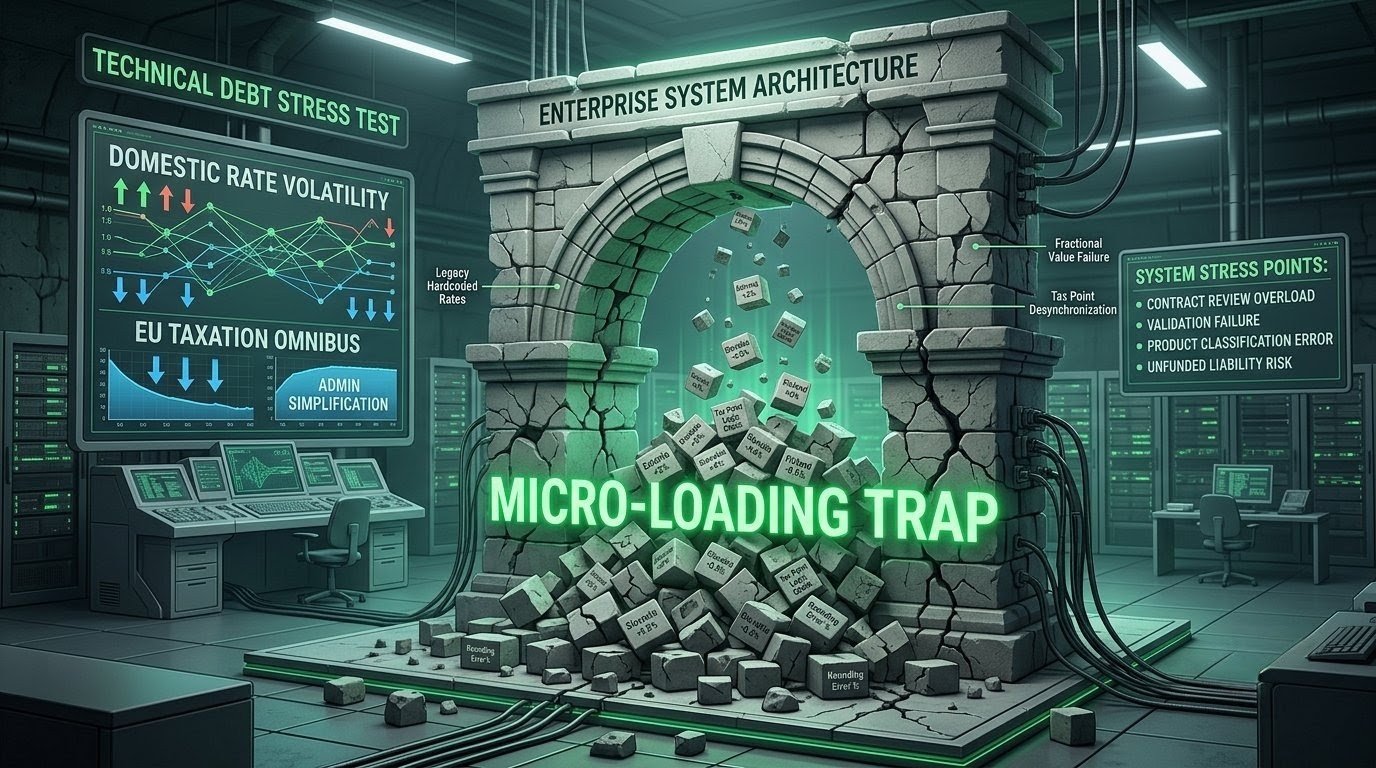
Every serious lifter knows the trick of micro-loading. Instead of jumping from one heavy plate to the next, you add a small fractional plate, half a kilo here, a quarter kilo there, so the body can keep adapting without breaking down. It looks like a tiny change on the bar. It is rarely a tiny change for the joints, the tendons, and the nervous system that have to absorb it.
Europe’s tax authorities have been running their own version of micro-loading for the past year. While most compliance teams were watching the big lifts, electronic invoicing mandates, the Value Added Tax in the Digital Age initiative, the abolition of customs de minimis, a quieter set of small percentage adjustments moved through Estonia, Slovakia, and Finland between mid-2025 and January 2026. None of those changes made front-page news, and most businesses have already absorbed them by now. What they exposed about enterprise systems along the way is still worth studying, especially with the European Commission adopting a large administrative simplification package, the Taxation Omnibus, just three weeks ago, on 24 June 2026. That package is the freshest signal yet of how Brussels is trying to answer the strain these small national changes keep creating.
The Load: Three Small Changes, Three Different Injuries
Three member states raised or lowered VAT rates between mid-2025 and early 2026, and each one stressed enterprise systems in a different way. Looking back at them together is useful precisely because the dust has settled. Think of them as three training sessions already logged, each one revealing a separate weak point in the system’s structure.
| Country | What changed | Effective date |
|---|---|---|
| Estonia | Standard rate 20% to 22%, then 22% to 24%, now permanent | 22% from January 2024, 24% from 1 July 2025 |
| Slovakia | High-sugar and high-sodium foods moved from the 19% reduced rate to the 23% standard rate | 1 January 2026, under Law 261/2025 |
| Finland | Standard rate raised to 25.5% in 2024, reduced rate cut from 14% to 13.5% | Reduced rate cut effective 1 January 2026 |
Estonia: The Straight-Line Lift That Was Not Straight
Estonia’s move looked like the simplest kind of load increase, a straight percentage bump from 22% to 24%, confirmed as a permanent rate rather than a temporary defence measure, effective 1 July 2025. On paper this was a single-field update. In practice, any invoice or contract that straddled the changeover date had to be tested against the tax point rules. Was the delivery completed before the change, or after. Was an advance payment received under the old rate. A year on, the lesson still holds for the next country that raises its rate: systems that treat VAT rate as a static lookup value, rather than a function of delivery date, invoice date, and payment date, will misprice exactly the transactions that fall in that window.
Slovakia: The Recipe-Level Rep
Slovakia’s change was the more interesting lift, because it did not touch a whole category. Law 261/2025 pulled specific high-sugar and high-sodium foods out of the 19% reduced rate and pushed them to the 23% standard rate from 1 January 2026, covering items like chocolate, sweetened soft drinks, and salty snacks, while leaving staples such as bread, dairy, and baby food untouched. Six months in, retailers that had built their enterprise resource planning system to classify an entire “snacks” category under one tax code had to unwind that shortcut fast. Someone, usually a product or supply chain team rather than a tax team, had to confirm the actual sugar and sodium content of each product before the correct rate could be assigned, and that requirement has not gone away. If a manufacturer reformulates a product to cut sodium, the tax classification still has to shift with it. That is a tax decision that now lives inside a recipe database, permanently.
Finland: The Two-Directional Set
Finland ran two different movements within about eighteen months of each other. Having already pushed its standard rate to 25.5% in 2024, one of the highest in the European Union, it trimmed its reduced rate from 14% to 13.5% from 1 January 2026, covering food, passenger transport, accommodation, and pharmaceuticals. Running a rate increase and a rate decrease through the same system in that short a window was its own kind of coordination challenge, and the fractional figures involved, 25.5% and 13.5%, exposed older accounting software that was only ever built to handle whole or single-decimal percentages. Systems that round a fractional VAT calculation incorrectly across thousands of monthly invoices do not stay off by a little. The gaps compound into ledger imbalances that someone in finance has to chase down at month end, and Finnish filers are still living with that risk every reporting cycle.
The Muscle Memory Problem
Outside observers tend to assume that updating a tax rate in a modern system is a five-minute task. It rarely is, because corporate invoicing platforms do not store one tax rate per country. They run a matrix that checks supplier location, customer location, product classification, and the exact moment ownership or service delivery occurred, before landing on a rate.
Slovakia’s recipe-level rule is the clearest illustration of this. A system cannot simply read a product category label and apply a rate anymore. It has to receive nutritional data from a product lifecycle system, translate that into a tax classification, and keep that link updated every time a formulation changes. Miss that update in one direction and a business overcharges customers, which damages trust with retail partners. Miss it in the other direction and the business quietly builds up a liability that a tax authority, increasingly equipped with the kind of algorithmic risk-scoring tools already in use elsewhere in the EU, will surface during a routine audit.
The transitional timeline is the second weak point, and it shows up in Estonia and Finland alike. Under EU VAT rules, the tax point, not the contract date, decides which rate applies. A system has to weigh the date the service was actually delivered, the date the invoice was issued, and the date any advance payment landed in the bank account. Get that sequencing wrong on a multi-stage contract, a maintenance agreement or a long construction project for instance, and the business is applying an outdated rate to part of a transaction without realising it.
The Recovery Day: Brussels Just Tried to De-Load the System
While national governments kept making local adjustments like the three above, the European Commission has been working on the opposite problem, cutting administrative bulk rather than adding it. Just three weeks ago, on 24 June 2026, the Commission adopted a tax simplification package built around a proposal known as the Taxation Omnibus, alongside a recast of the Directive on Administrative Cooperation. This is the part of the story still actively unfolding. The Commission estimates the combined package could reduce business compliance costs across the EU by approximately 7.9 billion euros a year.
The package touches six major direct tax directives, and the headline moves include removing duplicate reporting between Controlled Foreign Company rules and the global minimum tax framework, excluding low-risk third-party bank financing from anti-avoidance interest limits, replacing fragmented national anti-abuse options with one shared model, and setting firmer timelines for withholding tax relief and refunds.
Think of this as the EU’s attempt at a de-load week for corporate tax administration, easing the cumulative strain built up from years of overlapping directives. It sits alongside earlier moves in the same direction, including the elimination of the call-off stock simplification under ViDA, even as the surveillance side of the ledger keeps expanding through frameworks like CESOP’s cross-border payment reporting. But a de-load week for Brussels does not cancel the domestic training load in Tallinn, Bratislava, or Helsinki. Corporate tax teams are left tracking two opposite trends at once, more administrative integration at the EU level, and continued rate fragmentation at the national level. Simplification in one place is being offset by complexity in another, and the compliance calendar does not get any shorter as a result.
The Human Cost of Constant Micro-Loading
Behind every one of these rate changes is a real person, usually in master data, product information management, or indirect tax, who has to update the system before the effective date arrives. A single rate change in one country can trigger a cascade of manual checks across a large catalogue: customer contracts need review, intercompany billing needs recalibration, and procurement systems need retesting so that an outdated supplier invoice does not get automatically rejected on receipt.
This is where technical debt turns a manageable adjustment into a genuine strain. Many enterprise systems carry years of custom scripts layered on top of the core platform, each one written to solve a specific problem at the time. A script built a decade ago to handle a simple country-level VAT lookup was never designed to process recipe-level nutritional data. When it fails, the fallback is a manual workaround, and manual workarounds are exactly where human error creeps back into an otherwise automated pipeline. There is also a quieter performance cost: as the tax determination matrix gets more complex, real-time invoicing systems take longer to query it, and in high-volume retail or e-commerce environments, even a small added delay per transaction can slow down checkout at scale.
Training Protocol: Five Moves to Handle Rate Volatility
- Keep the tax engine separate from the core lifts. Avoid hardcoding rates or rate logic directly into the main ERP application. A centralised, external tax engine can absorb a rate update without a full software release cycle.
- Build contract review into the regular program, not a one-off session. Set up automated monitoring of multi-year supply agreements for tax clauses, so a mid-contract rate change does not require a manual renegotiation every time.
- Add validation checks at the point of entry. Automated flags on incoming supplier invoices that carry an outdated local rate stop the error before it reaches the general ledger, rather than after.
- Connect product data to tax classification directly. Where a rate depends on product composition, as in Slovakia, the product database needs to be the source of truth that automatically updates the linked tax code.
- Keep a standing team, not a reactive one. A small cross-functional group of tax, data, and IT people tracking upcoming domestic legislation turns rate management into an ongoing discipline instead of a fire drill every time a bill passes.
Sources
- EY Estonia, “Significant tax changes in Estonia in 2025-2026”: ey.com
- Estonian Tax and Customs Board, VAT rates guidance: emta.ee
- Crowe Slovakia, “Changes in tax laws in connection with the consolidation package”: crowe.com
- Marosa VAT, “Slovakia to Increase VAT on Unhealthy Foods from 2026”: marosavat.com
- Marosa VAT, “Finland to Lower the Reduced VAT Rate to 13.5% from January 2026”: marosavat.com
- BDO Global, “Finland – Reduced VAT Rate Drops”: bdo.global
- European Commission, Taxation and Customs Union, “European Commission proposes landmark tax simplification package”: taxation-customs.ec.europa.eu
- IBFD, “European Commission Adopts Tax Simplification Package: Taxation Omnibus”: ibfd.org
The Green Ledger: India’s CBAM Carbon Compliance Playbook
Digital Cardio: EMEA E-Invoicing and Real-Time Compliance
The Three Pillars of ViDA: EU’s Real-Time VAT Revolution
CESOP: How the EU Now Watches Every Cross-Border Payment
DAC7 and DAC8: Marketplace Reporting for Indian Sellers
The AI Audit Trap: EU Algorithmic Tax Risk Scoring Explained
EU ViDA: The End of Call-Off Stock Arrangements by 2029
The Death of De Minimis: What Indian E-Commerce Sellers Must Do